A product demo should show who helps and how long assembly takes
In a sample of 600 product reviews, assembly came up much more often than concrete details about time, people or tools. For businesses and creators planning a demonstration, that gap changes what to film.
Original analysis of 600 review records from 60 products in a Wayfair dataset released in 2025.
Abstract
A useful assembly segment in a product demonstration video shows what people actually do and explains the time involved. In our fixed sample of 600 review records from 60 products, 218 explicitly mentioned assembly or installation. Only 19 gave a numerical or bounded duration, 28 described working alone, help or a worker count, and four named a tool or explicitly said none was required. Most assembly mentions contained none of these three kinds of detail.[1][2]
These are counts of information in review text, with overlap between the detail types. They suggest a practical assignment for businesses and creators: verify the relevant stage on the current product, show each person’s role, and explain the start, finish and interruptions behind any assembly-time claim. The findings describe this selected sample from a 2025 dataset release; they do not measure what buyers value most or whether a video increases sales.
Imagine a furniture business commissioning a creator to demonstrate a compact desk. The proposed video moves from an unopened box to a finished workspace, with close-ups of the surface and drawers. Its assembly brief says little more than that the desk should look straightforward to build.
Before filming, the creator asks two practical questions: will anyone need to hold a part while someone else fastens it, and how much time should the team allow? A favorable review about assembly may not answer either. A finished-product shot cannot show the missing steps.
That fictional planning problem led us to examine what assembly comments actually contain. We found plenty of references to putting a product together, but far fewer of the particular details that could inform these decisions. The useful response is a more specific filming brief: make the work visible, then explain the conditions under which it happened.
The preparation behind a finished product
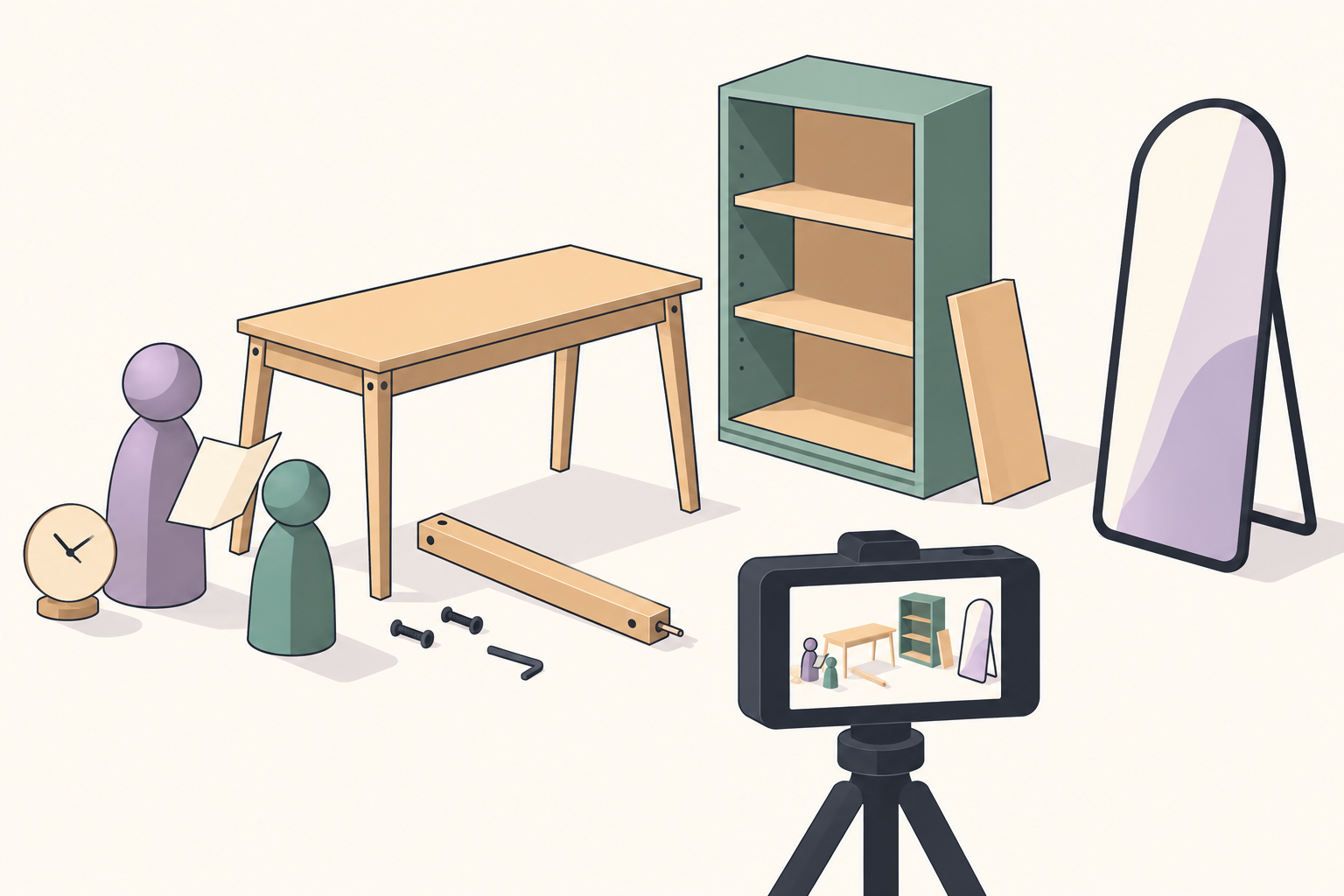
- The parts to assemble
- Who does the work
- What the elapsed time includes
Assembly mentions often stop short of preparation details
We selected 200 review records in each of three source categories: Wall & Accent Mirrors, Bookcases and Desks. Each category contributed 20 products and ten records per product. The resulting 600-record sample stayed fixed throughout the analysis. It includes favorable, unfavorable and brief comments, rather than only reviews that discuss assembly.[2][3]
Of those records, 218 clearly mentioned assembly, mounting, installation or the absence of an assembly requirement. Another 13 were ambiguous. The detail counts were smaller: 19 for duration, 28 for people or help, and four for named tools or an explicit no-tools statement. A single record could contribute to several detail columns.
Assembly mentions and specific preparation details in the selected reviews
Counts within the fixed sample: 200 review records per source class and 600 overall. Each class contributes 20 products.
| Source product class and fixed record base | Assembly or installation mentions | Numerical or bounded duration | Working alone, help or worker count | Named tool or explicit no-tools statement |
|---|---|---|---|---|
| Wall & Accent Mirrors (200 records) | 37 | 0 | 1 | 0 |
| Bookcases (200 records) | 85 | 8 | 14 | 2 |
| Desks (200 records) | 96 | 11 | 13 | 2 |
| All three classes (600 records) | 218 | 19 | 28 | 4 |
The people column includes solo work as well as help and explicit worker counts. It does not mean that 28 reviews said another person was needed. Similarly, mentioning assembly includes saying that a product arrived assembled. That statement alone tells us nothing about time, helpers or tools.
The gap matters at the point where a producer must turn an impression into a scene. A comment can establish that assembly was discussed without saying who held a component, which stage required attention or when the clock started. Those details still need to come from the demonstration itself.
The counts concern the selected review text. We did not inspect product specifications or existing videos, so an absent detail here is not evidence that the seller has failed to explain it elsewhere. The opportunity is to give the creator a clearer assignment for this particular film.
Show each person’s role at the stage where it matters
Details about working alone or with help appeared across 21 sampled products. This gives the finding a broader footing than a single memorable comment. It also points to a more useful production question than whether an entire product is simply easy or difficult to assemble.
Start with a named stage. A person might need to hold a panel upright, align two parts or keep a component steady while another person fastens it. Check the current instructions and try the intended demonstration before deciding what roles the scene needs. A reviewer’s experience is a reason to investigate that stage, not a universal staffing rule.
When help is part of the demonstration, use a view that shows the relevant people and the component at the same time. Explain what each person is doing. Close-ups can follow, but keep enough context for the viewer to understand whose hands are holding and whose are fastening.
If the creator performs the stage alone, describe that observed build accurately. Avoid quietly removing a helper from the frame and then presenting the result as solo work. Equally, a successful solo attempt should not replace an instruction that calls for assistance. The film and the current product guidance need to tell a consistent story.
Our coding separated completed experiences from advice. Some comments described work that had happened; others recommended help. One record contained both kinds of information. That distinction matters when writing a script: a personal experience and a recommendation give the producer different things to verify.
Turn a review detail into a scene you can explain
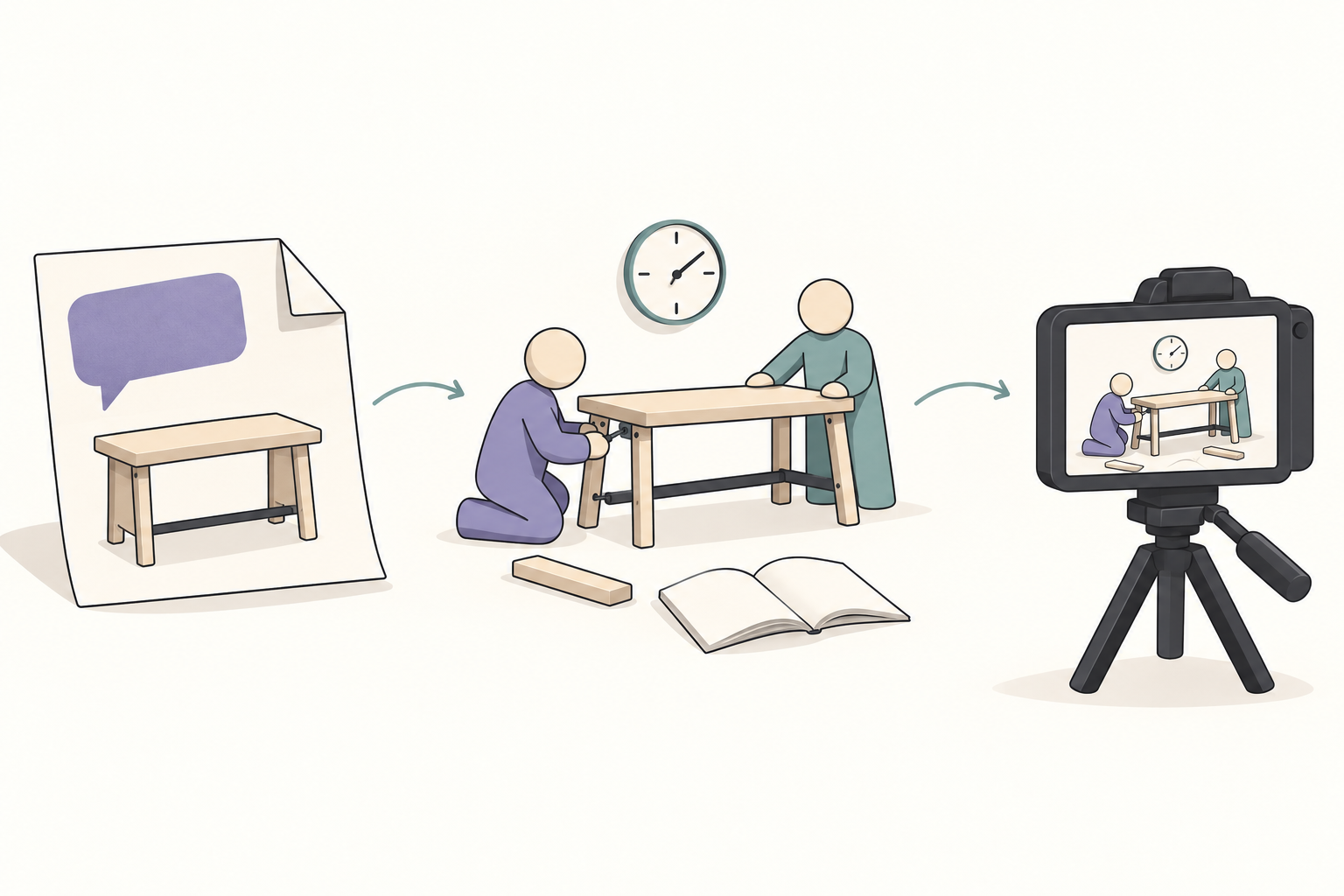
Read the specific detail
Identify a reported experience or piece of advice about time, working alone or getting help.
Check the current build
Use the current instructions and planned demonstration to establish the roles and timing conditions.
Film and explain
Show the relevant actions, state what the elapsed time includes, and make any time compression clear.
Explain the elapsed time behind the edited sequence
Numerical or bounded assembly durations appeared in 19 records across 12 products. Eighteen described performed work and one expressed advice or a general requirement. We retained approximations and bounds instead of combining different products and circumstances into an average assembly time.
A time in a review does not, by itself, supply a complete production log. It may leave the start point, preparation, interruptions or experience of the assembler unstated. Preserve what the reviewer actually said, then measure the build you plan to show. Do not borrow the review’s number as if it timed your demonstration.
Choose the start and finish before filming. For example, does the clock begin with a sealed box or with checked parts already laid out? Does it end when the main structure is joined or when every required installation step is complete? State those boundaries wherever you present the time.
Also note who worked and whether the person had assembled that model before. Keep track of pauses to reread instructions, find an item or reset the camera. You can distinguish those pauses in the explanation, but do not silently subtract them and label the remainder total elapsed time.
Editing creates a second clock. A short sequence may show a much longer build, and a time-lapse compresses waiting as well as action. Put the demonstrated elapsed time beside the sequence and make the compression clear. A viewer should not have to infer build time from video length.
The practical payoff is a specific claim the creator can support: what this build took under the stated conditions. That is more useful than promising that every buyer will finish in the same time, especially when the film starts after substantial preparation has already happened.
Copy this brief before filming the assembly segment
Use the following brief for a business commissioning a creator or for a creator planning their own demonstration. Fill it in after checking the current product and instructions. The fields turn a general assembly message into a scene that can be filmed, explained and checked before publication.
Product and stage: [Name the model or version and the assembly stage to show.] Describe what is happening at that stage in everyday language. Keep the brief focused on the part of the process that the scene will actually cover.
People and roles: [State who will hold, align, fasten or otherwise assist.] Separate any requirement in the current instructions from the roles used in your demonstration. Include the relevant participants in the shot, even if a later close-up focuses on one action.
Time and conditions: [Define the starting state, finishing state, people involved, prior experience and pauses.] Leave the actual elapsed time blank until the demonstration is timed. Note any preparation completed before the clock starts so the editor can explain it accurately.
Views and editing: [Choose the wide view, useful close-ups and any accelerated sequence.] Specify where the elapsed-time explanation will appear and which steps need normal-speed treatment. A caption should help the viewer interpret what happened, rather than conceal a jump between unfinished and finished work.
Check before publishing: [Name who will compare the finished segment with the demonstration log and current instructions.] Confirm the roles, timing boundaries and visible steps. If the footage cannot support a proposed line, change the line or capture the missing evidence before using it.
A worked example for the desk demonstration
Return to the fictional desk commission. The business and creator choose the stage where the top is positioned on the frame. In this invented example, they check the model’s instructions and decide to demonstrate that stage with one person holding the top while another aligns and fastens it. This is a planning example, not a requirement inferred for desks in our sample.
The revised shot list opens on the relevant parts and shows the two people moving into position. A wide view stays on the alignment stage so their roles are visible. A closer view then explains the fastening step. The creator describes the actions shown rather than calling the whole process effortless.
Fictional demonstration log: the build runs for 42 minutes from parts already checked and laid out to the stated finished condition. That includes a six-minute camera pause. The creator has assembled this model before. These invented details illustrate what belongs in the explanation; they are not measured results from our study.
A matching line for this fictional video would be: “This build took 42 minutes from checked parts to the finished desk, including a six-minute pause for the camera. I had built this model before. We used two people to position the top.” Each part of the line has a corresponding entry in the example log.
The editor can shorten repetitive footage while keeping the roles visible at the chosen stage. If the scene runs faster than real time, the caption explains that it is accelerated. The stated 42 minutes remains the elapsed time of the fictional build, not the length of the final video.
Now compare that assignment with the original brief. The team knows which stage must be visible, who appears, what the time means and which explanation belongs beside the footage. The improvement is in the information the finished demonstration can convey. We have not tested a sales or viewing effect.
Keep the same meaning when the demo becomes a short post
The full demonstration may become a short social post, a creator’s review and a product-page clip. Before making those edits, identify which context each version needs. If a short clip keeps the assembly-time claim but removes its starting conditions, the wording has become broader than the demonstrated result.
Keep the necessary explanation with the claim. A short version can still say that the clock started after parts were laid out, that the sequence is accelerated or that another person helped at the visible stage. If those facts will not fit, focus the clip on a narrower action that can be explained clearly.
A link to the longer demonstration gives viewers a useful next step. It should not have to correct a misleading impression created by the short version. Captions and a written description also let people understand the relevant roles and timing without relying only on spoken explanation.
Tool preparation can be part of the check, but it is a small secondary finding here. Only four sampled records named a physical tool or explicitly said no tools were required. Confirm the current instructions and actual demonstration needs; this count does not tell a creator which tool to recommend.
For the business, the finished brief becomes a practical handoff to the editor. For the creator, it keeps the explanation tied to work they actually observed. Both can review the footage against the same simple questions: can we see the roles, and can we understand what the stated time includes?
How we selected and read the review records
The source is the Wayfair review release associated with Boytsov and colleagues’ 2025 paper on review summarization. We used original review text, not the release’s generated summaries or aspect labels. The paper studies a different question; the assembly-detail counts and interpretation here are Influence IQ’s analysis.[1][2]
Before reading the selected text, we fixed the three native product classes and used a reproducible hash order to select 20 product IDs per class, then ten review IDs per product. We retained all 600 selected records. The Wall & Accent Mirrors class includes accent mirrors and should not be read as a wall-mounted-only category.[3]
Two independent AI coding passes read the texts without product identities or class labels. We compared their decisions and reviewed disagreements and supporting passages under rules fixed before coding. Agreement describes consistency between those passes, not measured accuracy or human validation. The public analysis files include their agreement tables and the adjudicated counts.[5]
A duration needed a number or bound linked to assembly or installation. People information needed an explicit worker count, solo statement or assistance. Tools needed a named physical tool or an explicit no-tools statement; screws and other hardware did not qualify. Generic ease, vague time and an unqualified “we” were insufficient for those details.
The tables below separate reported work from advice, retain ambiguous details and show absences within every fixed base. People information was definite in 28 records and ambiguous in three; tool information was definite in four and ambiguous in one. All 19 duration cases were definite. Counting ambiguous cases either way leaves the main finding intact: most assembly mentions did not contain any of these three details.
The release does not establish individual review dates, customer identities or geography for this sample. We therefore describe records from a 2025 release, rather than current buyers in a named market. These are review records, not a count of distinct customers, and the sample does not support population estimates. The downloads preserve the complete counts and reproducible rules without publishing source review text or source identifiers.[4][5]
Duration: reported work, advice and unresolved detail
All selected records classified for numerical or bounded assembly/installation duration. Each row uses the fixed base in its label.
Show all duration counts
| Source product class and fixed record base | Reported work only | Advice or requirement only | Reported work and advice | Basis unclear | Detail uncertain | Absent from the text |
|---|---|---|---|---|---|---|
| Wall & Accent Mirrors (200 records) | 0 | 0 | 0 | 0 | 0 | 200 |
| Bookcases (200 records) | 8 | 0 | 0 | 0 | 0 | 192 |
| Desks (200 records) | 10 | 1 | 0 | 0 | 0 | 189 |
| All three classes (600 records) | 18 | 1 | 0 | 0 | 0 | 581 |
People and help: reported work, advice and unresolved detail
All selected records classified for working alone, assistance or explicit worker count. Each row uses the fixed base in its label.
Show all people and help counts
| Source product class and fixed record base | Reported work only | Advice or requirement only | Reported work and advice | Basis unclear | Detail uncertain | Absent from the text |
|---|---|---|---|---|---|---|
| Wall & Accent Mirrors (200 records) | 1 | 0 | 0 | 0 | 0 | 199 |
| Bookcases (200 records) | 10 | 3 | 1 | 0 | 1 | 185 |
| Desks (200 records) | 10 | 3 | 0 | 0 | 2 | 185 |
| All three classes (600 records) | 21 | 6 | 1 | 0 | 3 | 569 |
Tools: reported work, advice and unresolved detail
All selected records classified for named physical tool or explicit no-tools statement. Each row uses the fixed base in its label.
Show all tools counts
| Source product class and fixed record base | Reported work only | Advice or requirement only | Reported work and advice | Basis unclear | Detail uncertain | Absent from the text |
|---|---|---|---|---|---|---|
| Wall & Accent Mirrors (200 records) | 0 | 0 | 0 | 0 | 0 | 200 |
| Bookcases (200 records) | 0 | 2 | 0 | 0 | 0 | 198 |
| Desks (200 records) | 1 | 1 | 0 | 0 | 1 | 197 |
| All three classes (600 records) | 1 | 3 | 0 | 0 | 1 | 595 |
- Download the English review-detail counts (CSV)
- Download the method, derived annotations and code (ZIP, English)
No sign-up required. The downloads contain aggregate counts and an English technical package with anonymous derived annotations. They exclude source review text and original identifiers. Obtain the source datasets separately through their published release pages.
Sources and notes
- Ilya Boytsov and colleagues, End-to-End Aspect-Guided Review Summarization at Scale, EMNLP Industry Track, 2025. The paper describes the review-summarization system and associated Wayfair data release. Influence IQ’s assembly-preparation audit is a separate descriptive analysis; it does not repeat or validate the paper’s experimental findings.
- Wayfair customer reviews, released by IeBoytsov on Hugging Face. This analysis uses the pinned review release 31f0a7241dbb5ed6d4df7e6af4cb142fe7249a1d. The sample was read in its original wording and was not restricted to English. Individual review dates and customer geography are not established.
- Wayfair product summaries, released by IeBoytsov on Hugging Face. The pinned release cea911915820b9c1eb82c205cd44bc8afa8e6aa0 supplies product identifiers and native class labels for selection. Generated summaries were not used as evidence. The three classes are Wall & Accent Mirrors, Bookcases and Desks; each contributes 200 review records from 20 products.
- The source datasets are released under the Community Data License Agreement, Permissive, Version 2.0. Source credit: Wayfair and Boytsov and colleagues. Analysis and interpretation: Influence IQ. No affiliation with or endorsement by the source authors is implied.
- Influence IQ analysis package: selection and coding rules, anonymous derived annotations, complete counts, agreement tables and reproduction scripts. Files exclude raw review text, original review and product identifiers, generated summaries and source data files. Technical materials are in English.
All ten language editions describe the same selected records from a dataset released in 2025. Translation does not create findings for a local market. The technical analysis package is in English.