A new color can need a new product description
A material sentence can look reusable when the product name stays the same. We compared archived color variants to see how often their declared materials and percentages actually matched.
An original exploratory analysis of H&M and Uniqlo product disclosures archived in the UK and Australia in March–April 2026.
Abstract
Before reusing a clothing product description for another color, check its material statement. In 855 of 6,136 eligible comparisons of one product family in one market from an H&M and Uniqlo archive, the selected statement’s base materials or percentages differed across observed colors: 13.9%. The records cover the UK and Australia in March–April 2026. Of the eligible groups, 522, or 8.5%, differed in their material list or by at least five percentage points in one material.[1][2]
This is a comparison of archived disclosures, not a test of physical fabric or an estimate of today’s market. Matching one statement also does not establish that every component or claim matches. For brands and creators, the useful step is to keep the exact product color, the approved material wording and its source together when a brief changes.
A creator has the product, the photographs and a caption ready to go. Then the brand asks for a different color. The visual change is easy to spot. The material sentence buried in the caption is less obvious.
It is tempting to treat that sentence as a fact about the whole style. If the name and shape remain the same, why would a different color need different wording? The archived records in this study show why that assumption deserves a check.
Advice to verify fabric details is not new. Our contribution is a matched comparison: we looked within the same product family and market, on the same recorded date, to measure how often a clearly defined material statement differed. The resulting examples turn a general instruction to “check the details” into a more specific handoff between a business and a creator.
The color shown and the material statement belong together
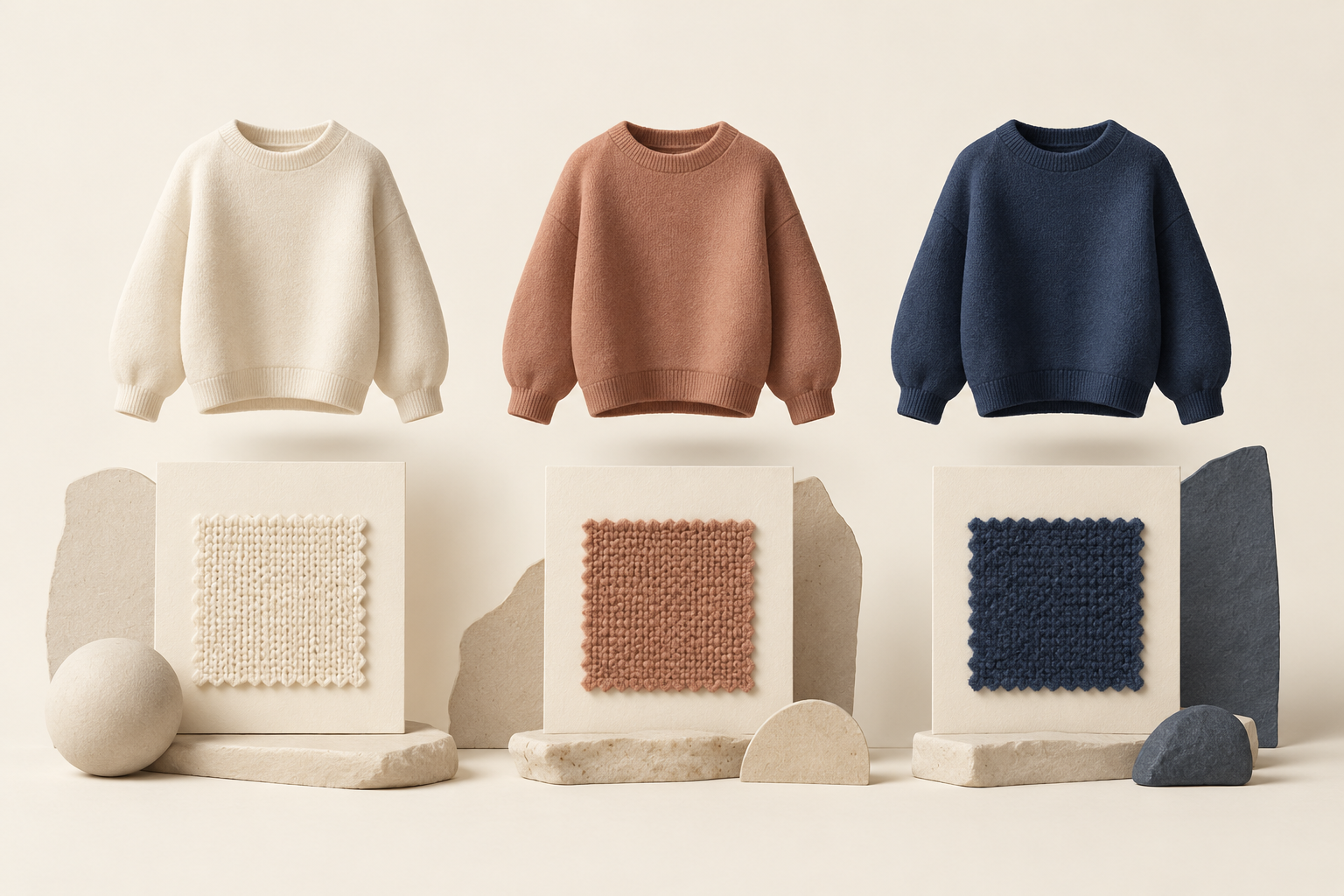
A color change can change the material sentence
We compared colors within the same archived product family and market, using records collected on the same date. A family counted once, whether it contained two observed colors or ten. That keeps a product with many colors from dominating the result simply because it has more listings.
Among 6,136 eligible family-and-market groups, 855 had at least two different combinations of declared base materials and percentages: 13.9%. The other 5,281 groups matched on those material categories and percentages. These groups come from H&M and Uniqlo pages in the UK and Australia captured in March and April 2026.[1][2]
The differences were not all alike. In 371 groups, at least one material appeared in one observed color’s statement and not another’s. Another 151 kept the same materials but differed by at least five percentage points in one material. The final 333 had smaller percentage differences. A change in the material list took precedence, so these categories do not overlap.
Together, the first two categories account for 522 groups, or 8.5% of the eligible total. Five percentage points is a descriptive threshold chosen for this analysis, not a rule about quality, labeling or acceptable error. Even a smaller difference matters if a caption repeats an exact percentage.
The unit also matters. These are 6,136 product-family-and-market comparisons, not 6,136 independent global styles or purchases. A family appearing in both countries contributes two groups. The 855 changed groups represent 782 distinct brand-and-family identifiers across the archive.
Different material names and different percentages are separate cases
All 6,136 eligible same-day product-family-and-market groups. Each group appears once.
| Result | Groups | Share of eligible groups |
|---|---|---|
| Matching material categories and percentages | 5,281 | 86.1% |
| At least one material added or absent | 371 | 6.0% |
| Same materials; largest change at least 5 percentage points | 151 | 2.5% |
| Same materials; largest change below 5 percentage points | 333 | 5.4% |
One linen-blend product, several material statements
The archived Australian H&M records for a tailored linen-blend pants family make the distinction concrete. On March 30, 2026, its white version listed a shell of 68% viscose and 32% linen. The dark gray version listed 43% viscose, 31% linen and 26% cotton. Both appeared within the same derived product family, but cotton appeared in only the second of those two shell statements.[3]
The other observed colors added detail to the picture. Black listed 69% viscose and 31% linen. Light beige and dark brown each listed 45% viscose, 30% linen and 25% cotton. All five separately listed a pocket lining of 100% polyester. The comparison therefore concerns the shell; it does not turn the lining into part of the shell formula.
For a creator, “linen blend” and an exact composition sentence carry different levels of detail. The broad phrase may remain relevant across these archived variants, while “68% viscose and 32% linen” belongs to the white shell statement. Copying that exact sentence into a post showing the dark gray version would lose the difference visible in the source.
The example identifies a possible handoff problem; it does not show that a campaign made that mistake. A brand preparing a brief now can pair the selected color with approved wording from its current product records. That gives the creator an exact source to use instead of relying on the shared product name or the historical numbers shown here.
The material names can match while the percentages change
A different example comes from Uniqlo’s Australian archive. A jersey-jacket family had body statements of 68% cotton, 27% polyester and 5% elastane for beige and red, compared with 74% cotton, 22% polyester and 4% elastane for blue. The material names matched, but cotton differed by six percentage points.[4]
That distinction matters when someone checks only for familiar words. Seeing cotton, polyester and elastane in both versions is not enough to approve a sentence that includes percentages. The numbers need to follow the selected color too. Our comparison treated six percentage points as 74 minus 68, rather than describing it as a 6% relative change.
The same archive also contains a smaller boundary case: two Australian H&M suit-pants colors listed shells of 65% polyester, 33% viscose and 2% elastane, versus 70%, 28% and 2%. The largest change was exactly five percentage points. Their pocket linings were recorded separately and were not included in that shell calculation.[3]
None of these differences tells us why a formula changed or whether one version performs better. Manufacturing, sourcing and physical testing are outside the records we analyzed. The useful conclusion for product copy is narrower: a matching list of material names does not establish a matching composition sentence.
Matching one part does not approve the whole description
The 5,281 matching groups are not a pool of product descriptions that can automatically be reused. We compared one clearly defined statement per color: a complete standalone material list, or a named main, body or shell component. Other parts can still differ.
For example, six colors or designs in an archived Australian H&M five-pack underwear family all listed a shell of 95% cotton and 5% elastane. Yet the accompanying lining statements differed. One front lining repeated 95% cotton and 5% elastane; another front lining listed 100% cotton; other variants named a separate crotch lining of 100% cotton.[3]
The shell comparison correctly counts that family as matching. It would be incorrect to expand the result into “all material text is identical.” It would be equally incorrect to assume that differently named lining parts describe the same physical area. Keep the component name attached to the statement when sharing it.
Our analysis also grouped materials into fixed base categories. It did not measure every distinction in sourcing, fiber grade, finish, recycled-content wording or marketing language. A match on those base categories and percentages is a limited result. It does not approve a sustainability claim, a care instruction or a description of how the product feels.
For a business, this suggests a useful division of work. Shared copy can explain the product’s overall story when the brand has confirmed it applies. Color-specific facts should remain attached to the relevant version. A creator should be able to see which sentences are shared and which need checking when the visual changes.
The archive supports a copy check, not a retailer ranking
The combined result comes from four different source sites, and their records do not contribute equally. The table shows both the eligible comparisons and how much of each initial same-day comparison frame survived the full text checks. That coverage is part of interpreting each rate.
Across all four sites, 7,324 groups passed the initial identity, color and date checks. Of those, 6,136, or 83.8%, met the complete material-text rules. We excluded the other 1,188 rather than repair ambiguous wording, ignore an alternative formula or treat an unresolved group as a match.
Coverage was lower for the Uniqlo records. Their source text could contain shared statements, defaults and separate color or product branches. An additional check limited Uniqlo to explicitly assigned colors and retained only 39 groups across both markets, below our chosen minimum of 50 for interpreting that sensitivity. It cannot establish a stable Uniqlo rate.
That is why the four percentages should not be read as a quality league table. Source structure, retained products and disclosure forms differ. The archive is not a representative sample of all retailers or a measurement of current catalogs. Its contribution is the observed within-family comparison and the concrete situations it reveals.
Read the result alongside the records that qualified
Eligible groups are the denominator for the difference rate. The initial frame passed identity, color and same-date checks before complete material-text checks.
| Archived source site | Groups with a difference | Eligible groups | Difference rate | Initial frame | Share of frame retained |
|---|---|---|---|---|---|
| H&M Australia | 237 | 1,580 | 15.0% | 1,733 | 91.2% |
| H&M UK | 586 | 3,666 | 16.0% | 4,033 | 90.9% |
| Uniqlo Australia | 15 | 379 | 4.0% | 697 | 54.4% |
| Uniqlo UK | 17 | 511 | 3.3% | 861 | 59.3% |
| All four source sites | 855 | 6,136 | 13.9% | 7,324 | 83.8% |
Keep the selected color and its source together
Imagine a brand briefing a creator on a cream top, then replacing it with the navy version shortly before filming. The photo and product link get updated. The caption draft still contains the cream version’s exact material sentence. This is an illustrative workflow, not an error observed in the dataset.
The first useful check is identity: which product, market and color will actually appear? The next is the statement itself. Open the current source for that version, retain the component name, and compare every material and percentage used in the draft. If the source is incomplete or conflicts with the supplied brief, ask the product owner to resolve that point.
The brand can make this easier with a short source note beside the approved copy. A product link alone may open a default color or change after the brief is shared. Record the product identifier, selected color, market, source date and relevant material statement. That lets the creator understand exactly what the sentence refers to.
For a video, check spoken language, on-screen text and the caption together. For a carousel, check the text beside each color. For a paid ad, the same discipline applies to the asset and the copy approved for that variant. These are recommended review steps; the study does not measure how often those channels contain errors or what a correction does to sales.
For the material-copy check, revisit the claims that depend on the selected color. A confirmed sentence about the overall design may remain usable. An exact material formula needs its own comparison. Keeping those decisions separate makes the review more specific than asking someone to approve the entire brief again without saying what changed.
Once the wording is approved, keep the source reference with the finished content. If a later edit substitutes another color, the next person can see what needs to be revisited. This makes the handoff useful to a small business, an in-house content team and an independent creator working from the same product information.
Carry the source through the brief
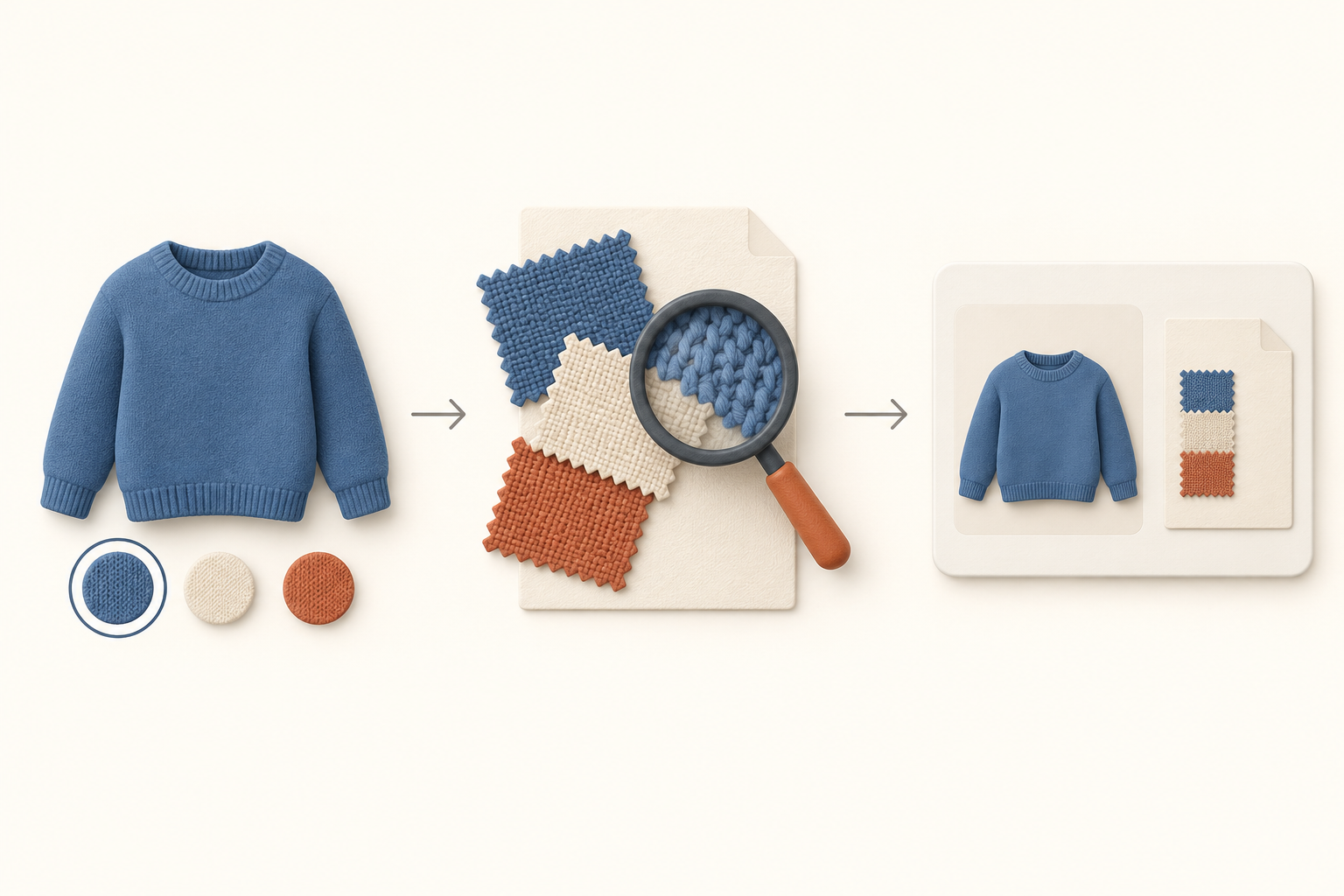
Identify the variant
Keep the product, color and market together.
Read the material statement
Preserve its component name, materials and percentages.
Match the content to the source
Review the wording beside the exact variant shown.
A short material-copy sheet for the next brief
Use this sheet for the exact variant shown in a post or video. It separates a source fact from the sentence you intend to publish. The download includes a blank version and a worked example based on the archived linen-blend records.[5]
Product: brand ______; product identifier ______; selected color or design ______; market ______; source link or document ______; checked on ______.
Material statement: component name exactly as supplied ______; material names and percentages ______; other parts mentioned separately ______; person responsible for the current product information ______.
Proposed content: asset showing this variant ______; exact material sentence ______; where it appears, including spoken or on-screen wording ______; source reference ______.
If switching variants: previous color ______; new color ______; materials added or absent ______; percentages changed ______; component names changed ______; revised sentence ______.
Decision: wording matches the approved current source / clarification needed / remove the unsupported material sentence. Reviewer ______; date ______; final content reference ______.
In the historical linen-blend example, a white-to-dark-gray change would replace the shell sentence “68% viscose and 32% linen” with “43% viscose, 31% linen and 26% cotton.” That is an illustration of matching copy to the archived source, not approval to advertise a current product with those numbers.
If the campaign only needs a broad description, ask the brand which wording applies across the selected variants. Do not introduce a precise percentage merely because it appears in an old caption. The sheet should preserve useful specificity while making the source of each specific claim clear.
- Download the material-difference and coverage tables (CSV)
- Download the analysis, review sheet and historical example (ZIP)
No sign-up required. The ZIP contains aggregate results, calculation code and the blank sheet with its worked example. Technical reproduction instructions are in English. The original source data remain with their authors under CC BY 4.0.
How we compared the archived disclosures
We used the complete 47,522-record public release created by Kai Li and Grit Walther. The archive contains product identifiers, markets, colors, collection timestamps, preserved material text and structured component records. We checked the published file checksum before analysis.[1]
This is an exploratory analysis. An initial source audit exposed ambiguity in the producer-parsed text and a product-category mismatch. We then fixed stricter complete-text rules before recalculating the revised results. We kept the source-defined product scope, which can include sets, multipacks and misclassified non-apparel objects. We do not describe the denominator as individual garments.
For each brand, market and derived family identifier, all retained colors had to share a recorded collection date and a comparable disclosure form. We required a fully read standalone material list or one eligible named main, body or shell statement, totaling exactly 100%. Every original record and every preserved branch had to pass the source checks. Missing colors were not invented.
The matching comparison used fixed material categories and exact decimal percentages. It ignored list order, but it did not silently discard extra text, add a missing component heading or combine different component bases within a family. Preserved text and the producer’s structured components had to agree. The package documents each exclusion stage and the four disclosure bases separately.[5]
Two independently written calculations agreed on all included groups and results. A deterministic audit then reviewed 285 families covering 866 original records, including changed, matching and excluded cases. That checks the analysis against the retained source text; it does not verify the original web extraction or the physical products.
Keeping identical literal component headings left the main result unchanged. Allowing different recorded dates increased the comparison to 8,634 groups, of which 1,397 differed, or 16.2%. That broader result mixes date and color variation, so the same-day comparison remains primary. No confidence interval or market-wide estimate is implied by these descriptive archive counts.
Sources and notes
- Li, Kai and Walther, Grit. A harmonized fast-fashion garment-variant dataset for textile circularity and sustainability assessment, version 1.0.0, published May 3, 2026. Influence IQ analyzed the 47,522-record curated public JSONL release. The source contains retailer disclosures, not laboratory fabric measurements.
- Influence IQ exploratory comparison. Each observation is one eligible brand, market and derived product family with at least two retained color identities collected on the same recorded date. The 13.9% share is 855 ÷ 6,136. The four nonoverlapping result classes and all source exclusions are included in the analysis package.
- Archived H&M Australia examples: family 1283570, five linen-blend pants colors captured March 30, 2026; family 1262464, two suit-pants colors captured March 31; family 1010214, six five-pack underwear colors or designs captured April 6. Examples paraphrase the selected component disclosures and preserve separate lining statements. They are historical observations, not current product specifications.
- Archived Uniqlo Australia family E484846-000: beige and red body statements of 68% cotton, 27% polyester and 5% elastane, versus blue at 74%, 22% and 4%. Every preserved branch was checked. This audited example does not establish a retailer-wide rate; the explicit-color Uniqlo sensitivity retained only 39 groups across both markets.
- Influence IQ analysis package: source manifest, exploratory comparison rules, calculation code, aggregate tables, exclusion counts, blank material-copy sheet and historical worked example. The raw retailer-derived dataset is linked at its original host rather than redistributed in the download.
- Source-data credit: Kai Li and Grit Walther, licensed under Creative Commons Attribution 4.0 International. Influence IQ grouped and filtered the archived records, checked complete material text and calculated new aggregate comparisons. H&M and Uniqlo are source-site identifiers; no affiliation or endorsement is implied. Retailer images and raw HTML are not included.
Every language edition describes the same UK and Australian archive. A translation is not a new study of the country where that language is spoken.