Rain dates for outdoor shoots: compare the next day with next week
Ten years of airport records show different wet-day counts for two reserve intervals—and why a production brief still needs a fallback for the backup.
An original comparison of six fixed NOAA airport stations, using daily precipitation from 2016–2025.
Abstract
A backup date one week later was less often wet than the next day at all six airports in our 2016–2025 records. We compared both alternatives after starting days with at least 1 mm of precipitation, using the same threshold for each backup. The overall differences ranged from 5.8 percentage points at New York JFK to 26.1 points at Los Angeles International. Both backup days reached the threshold in 23 of 261 Los Angeles cases and 352 of 1,216 Seattle cases.[1]
For a business booking an outdoor creator shoot before useful date-specific forecasts, the finding supports discussing the interval and a second fallback separately. It does not identify the best date for a particular job. We measured full-day airport precipitation, including the liquid equivalent of snow, rather than rain at a venue during filming. A fixed 5 mm comparison and seasonal results also show why the headline gap cannot become a blanket instruction to wait a week.
A business and a creator can agree to “move it if it rains” while imagining different arrangements. The business may expect the shoot to happen tomorrow. The creator may have kept the following Saturday free. A venue may allow only one change. Until the brief names the actual reserve date, the team has agreed on an intention without securing a workable alternative.
This study addresses that early booking conversation. We compared two familiar choices: the next calendar day and the same weekday seven days later. For each qualifying wet day, we looked at both alternatives in the same historical record. This keeps the comparison tied to one starting day, instead of comparing unrelated collections of next-day and next-week observations.
The records offer a reason to make the interval explicit, then ask what happens if that reserve day is also unsuitable. They cannot price an extra hold, predict a future shoot or decide whether a brief shower would spoil the planned creative. Those decisions depend on the deliverables, location, timing and people involved. The useful output is a clearer production brief.
Make the reserve date explicit
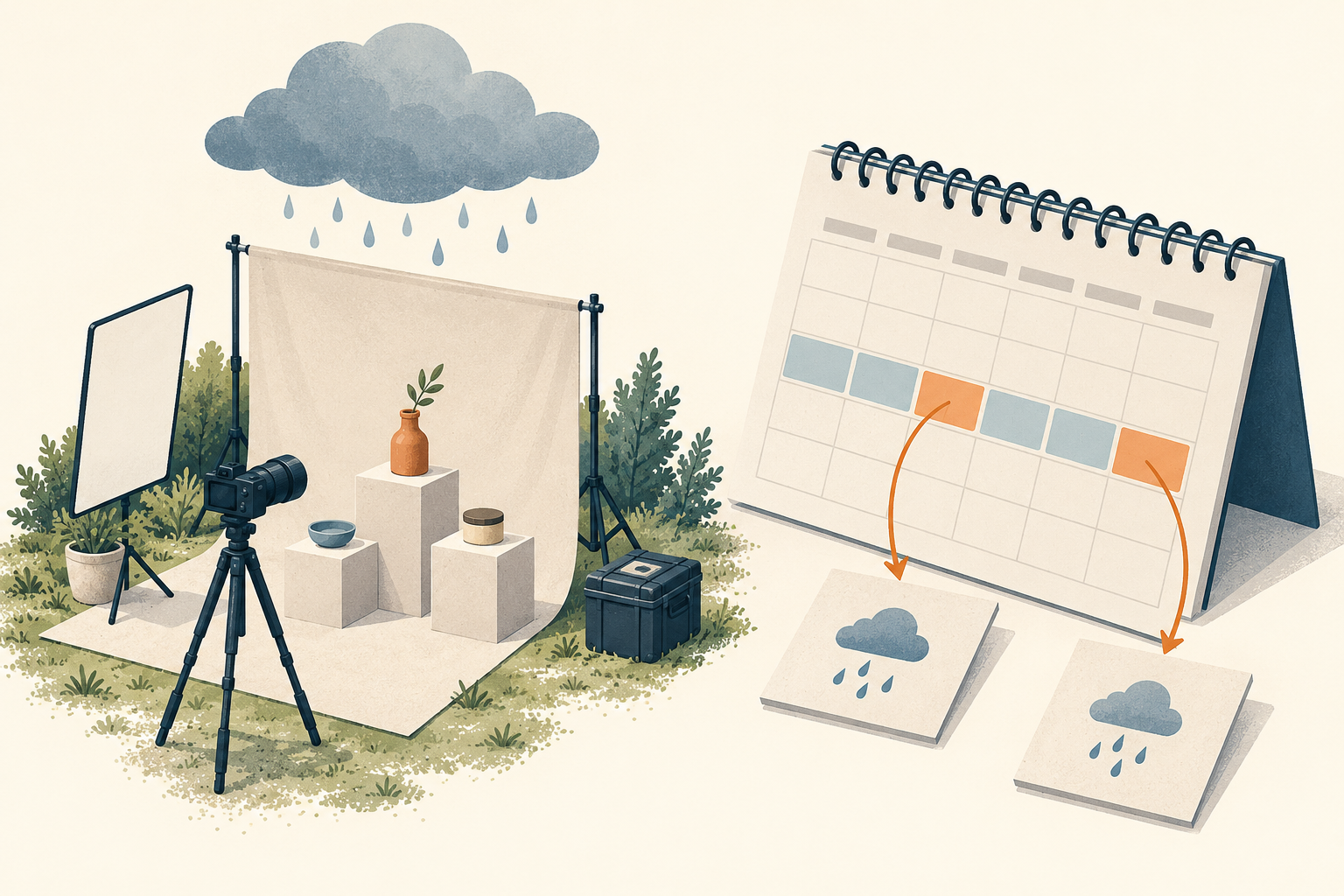
Compare two dates from the same wet starting day
Our main comparison calls an observation day wet when the airport recorded at least 1 mm of precipitation. We retained a starting day only when it and both backup days had eligible measurements. The base in each table row is therefore a set of complete three-date comparisons whose starting day was wet. It is not every day in the decade, every planned shoot, or every weather cancellation.
At Los Angeles International, for example, 116 of 261 next days reached 1 mm, compared with 48 of the corresponding days seven days later. Those counts produce 44.4% and 18.4%, a difference of 26.1 percentage points. Each percentage uses the same 261 starting days. The percentage-point gap is a difference between historical shares; it is not a 26.1% reduction in a business’s cancellation costs.
The first table keeps all six airports visible. Atlanta and Chicago also had lower overall shares at seven days, as did Miami and Seattle. But the size of the gap varies, and a lower share can still leave many wet backup days. Read across a row before comparing cities: the reserve date’s remaining share matters alongside the difference between the two intervals.[1]
This is a comparison of two specified choices, not a search for the best waiting period. We did not test every possible delay, and the records contain no actual booking decisions. A later date could mean losing a campaign deadline or a particular creator’s availability. The historical gap gives the team something concrete to discuss; it does not decide that tradeoff.
After a day with at least 1 mm, compare both backup dates
Each row uses the same complete wet starting days for both intervals. “Wet” means at least 1 mm of daily precipitation at the airport.
| Airport station | Wet starting days | Next day: wet count | Next day: wet share | Seven days later: wet count | Seven days later: wet share | Gap |
|---|---|---|---|---|---|---|
| New York JFK | 983 | 350 | 35.6% | 293 | 29.8% | 5.8 percentage points |
| Los Angeles International | 261 | 116 | 44.4% | 48 | 18.4% | 26.1 percentage points |
| Atlanta Hartsfield–Jackson | 958 | 396 | 41.3% | 258 | 26.9% | 14.4 percentage points |
| Chicago O’Hare | 968 | 373 | 38.5% | 260 | 26.9% | 11.7 percentage points |
| Miami International | 1,165 | 619 | 53.1% | 449 | 38.5% | 14.6 percentage points |
| Seattle–Tacoma | 1,216 | 716 | 58.9% | 544 | 44.7% | 14.1 percentage points |
Los Angeles, Miami and Seattle raise different questions
Los Angeles has the largest overall difference in this six-airport comparison. Yet a week-later hold did not make the historical wet-day cases disappear: 48 of 261 backup days still reached 1 mm. In 23 of those 261 comparisons, both the next day and the week-later day reached the threshold. For a Los Angeles product shoot, the conversation can therefore cover both the value of a more distant hold and a covered or indoor version of the brief.
Miami illustrates why the largest gap is not the only useful result. Its next-day share was 53.1% (619/1,165), and its week-later share was 38.5% (449/1,165). Both backups reached 1 mm in 267 cases, or 22.9% of the wet starting days. There were more cases with both backups wet than with only the week-later backup wet: 267 versus 182. Simply writing down two possible dates would not have resolved every historical case.
Seattle had a similar overall difference to Miami—14.1 versus 14.6 percentage points—but higher shares at both intervals. The next day reached 1 mm in 716 of 1,216 comparisons (58.9%); the week-later day did so in 544 (44.7%). Both did so in 352 (28.9%). A team choosing between intervals still needs to decide which deliverables could move indoors, which require the outdoor setting, and who can approve a change.
When both backups reached the threshold, that did not mean precipitation continued throughout the intervening week or that either shoot would have been cancelled. A full-day total could include precipitation outside the planned session. The count is useful because it keeps a second fallback on the agenda, while leaving the actual creative and timing decision with the production team.
These airport histories are not a ranking of places to commission creators. They describe different records, with different seasonal mixes and no matching of venues, budgets or creative requirements. Los Angeles also had only four qualifying summer starting days and 34 in autumn at the main threshold. Its overall result cannot carry a detailed claim about summer or every season. The full download keeps these smaller bases visible.[1]
JFK shows why the threshold belongs in the brief
A pristine outdoor product scene and a covered interview may tolerate very different conditions. Our 1 mm definition makes the records comparable; it is not a universal cancellation trigger. We therefore fixed a second comparison at 5 mm before examining the amounts, applying that threshold to the starting day and both backups. It selects a different, smaller set of starting days, rather than simply rescoring the original set.
At JFK, the overall difference shrank from 5.8 percentage points at 1 mm to 1.0 point at 5 mm. In the latter comparison, the next day reached the threshold in 121 of 579 cases and the week-later day in 115. That is a much narrower separation than the headline result might suggest. The other five airports had larger differences than JFK at 5 mm; the second table shows all six alongside the cases where both backups reached 1 mm.
Season also changes the JFK story. At 1 mm, its spring shares were 98/268 for the next day and 92/268 for the week-later day, a 2.2-point gap. In summer, they were 76/249 and 74/249, only 0.8 points apart. At 5 mm in summer, the direction reversed: 25 of 150 next days reached the threshold, compared with 34 week-later days, a gap of −6.0 points.[1]
That reversal does not establish a new summer scheduling rule. It shows how an overall comparison can hide a materially different answer for a specified season and threshold. Describe what makes the shoot unworkable—such as visible precipitation during an exterior scene or a wet surface that conflicts with the product styling—then use relevant forecasts and venue information as the date approaches. A daily airport total cannot tell whether those conditions occur at the shooting hour.
Both backups could reach 1 mm; the gap changes at 5 mm
The both-backup count and share use the 1 mm starting-day bases in the first table. The remaining columns use a new base of complete starting days with at least 5 mm.
| Airport station | Both backups ≥1 mm: count | Both backups ≥1 mm: share | 5 mm starting days | Next day ≥5 mm: count | Seven days later ≥5 mm: count | 5 mm gap |
|---|---|---|---|---|---|---|
| New York JFK | 97 | 9.9% | 579 | 121 | 115 | 1.0 percentage points |
| Los Angeles International | 23 | 8.8% | 149 | 49 | 20 | 19.5 percentage points |
| Atlanta Hartsfield–Jackson | 110 | 11.5% | 586 | 149 | 102 | 8.0 percentage points |
| Chicago O’Hare | 101 | 10.4% | 525 | 121 | 78 | 8.2 percentage points |
| Miami International | 267 | 22.9% | 708 | 264 | 177 | 12.3 percentage points |
| Seattle–Tacoma | 352 | 28.9% | 617 | 235 | 154 | 13.1 percentage points |
A product shoot, with the reserve choices written down
Imagine a fictional Los Angeles skincare business booking a creator for an outdoor product shoot several weeks ahead. The brief needs an exterior demonstration, close product details and a short interview. The first date is a Saturday. The creator can provisionally hold Sunday or the following Saturday, while a small indoor studio is another possible arrangement.
To make the example concrete, the note lists Saturday, May 8, 2027 as the first date, Sunday, May 9 as the next-day option, and Saturday, May 15 as the week-later option. Delivery is due May 20. Subject to confirmed availability and agreed terms, the team provisionally chooses May 15. It sets an initial decision meeting for noon on May 6, Los Angeles local time, and records who will arrange any later update. The note leaves the venue and hold terms open until confirmed.
The business records why the exterior demonstration matters: it needs the product shown in the planned outdoor setting. The close-ups and interview can move to an approved studio treatment, using the same products and claims. The shot list identifies these separate groups, so a location change does not quietly remove an essential deliverable. The creator and business can see exactly which part of the job remains unresolved if exterior filming cannot proceed.
The team uses the Los Angeles history to frame the date discussion: the week-later day had the lower overall share at 1 mm, but it still reached the threshold in 48 of 261 comparisons; both alternatives did so in 23. The May 15 option preserves a Saturday shoot but leaves less time before delivery than May 9. The business asks whether the editing and approval schedule can accommodate that shorter interval before confirming the hold.
Before the hold is confirmed, the creator and venue supply their availability, expiry times, change charges and latest decision times. The producer records the agreed terms beside each date. If a hold expires before the team’s planned decision meeting, the producer needs to resolve that mismatch while the option is still available. A date written into the brief is not secured until the relevant people have confirmed it.
The completed note names the producer to gather the current forecast and venue update, and the campaign lead to approve changed dates or deliverables. The creator receives the decision through the agreed channel. If the exterior demonstration remains essential and neither available date looks workable, that group must agree on a further change. The producer then updates the shot list, dates and delivery schedule together, so everyone works from the same revised brief.
A rain-date template to adapt with your creator
The downloadable template needs no sign-up. Copy it into the brief while dates are still being discussed, and complete it together with the creator and venue. Keep unresolved items visible until the person responsible confirms them.
Production and location: name the campaign, outdoor setting, intended shooting hours and required deliverables. Explain which features of the location or light matter to the creative. Separate work that needs the outdoor setting from work that can move to a named alternative with approval. Record the delivery deadline that constrains a postponement.
Dates and holds: enter the original date, next-day option and same-weekday-next-week option as actual calendar dates. Mark whether each is available, provisionally held or confirmed. Name the contact, hold expiry and agreed process for changing the booking. Ask for any relevant charges or restrictions explicitly; the study supplies none of those terms.
Conditions and decision: describe the conditions that would interfere with the planned work, the forecast and local information to review, and the person who will review them. State when the team will decide, who can approve a change and how everyone will be notified. Keep safety decisions under the appropriate venue and official guidance; a precipitation amount in this article is not a safety threshold.[4]
Fallback and delivery: specify what happens if the reserve date is also unsuitable. Identify any approved covered or indoor treatment, the deliverables it can preserve, the ones it cannot, and who must approve a different brief. If a date, venue or creative requirement changes, update the note so the creator and business are working from the same agreement.
Put the interval, conditions and fallback into the brief
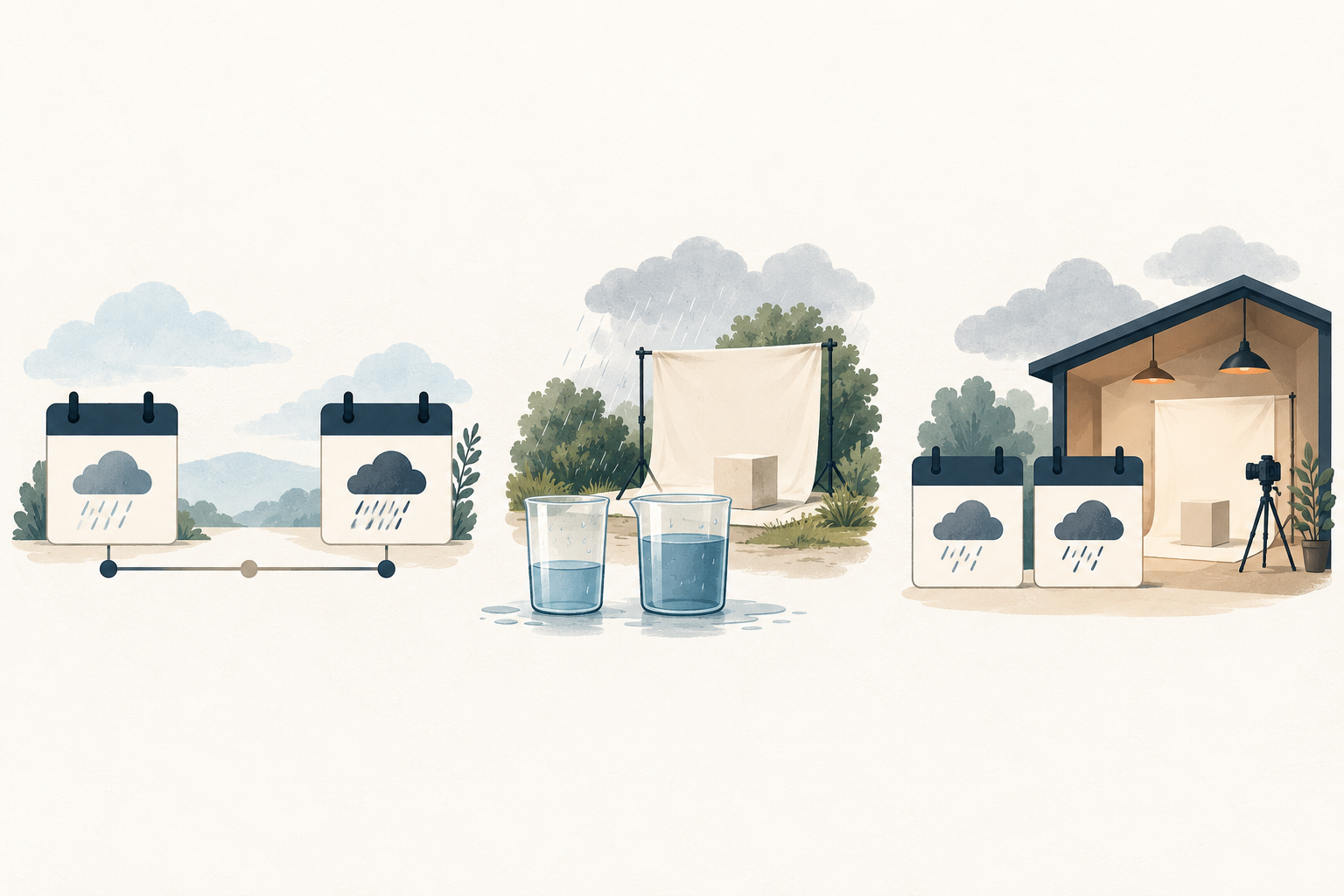
Name the dates
Write the original and reserve dates, holds and decision time.
Describe workable conditions
Connect the conditions to the actual deliverables and location.
Agree on the fallback
Record what can change if both outdoor dates are unsuitable.
No sign-up required. The ZIP includes the planning template and fictional example alongside the full analysis. Technical records and reproduction instructions are in English.
How we made the comparison
We analyzed daily precipitation from NOAA’s Global Historical Climatology Network–Daily for six fixed airport stations during 2016–2025. The choices, dates, 1 mm and 5 mm thresholds, record checks and comparison rules were frozen before inspecting the precipitation amounts. All results are descriptive counts from the 2016–2025 records. Earlier research has examined wet-day persistence; our contribution is this bounded comparison of two reserve-date choices and its production-planning interpretation.[2][5]
The eligible observation day ended at 24:00 local standard time, which does not move with daylight-saving time. PRCP is precipitation, including the liquid equivalent of frozen precipitation. We required the specified daily source and observation-time records, excluded disallowed or missing values, and did not allocate multiday totals. Trace observations fall below both study thresholds; “below 1 mm” should not be read as “no precipitation.”[2][3]
Every station passed the fixed coverage rules. Five had all 3,653 daily observations in the window; Seattle had 3,647. Its six missing days removed 17 otherwise possible three-date comparisons. The conservative missing-record bounds for Seattle’s overall 1 mm gap were 12.6–15.3 percentage points, still above zero. These are bounds for missing records, not confidence intervals or uncertainty about a future date.[1]
The overall direction also remained the same at every station in each five-year half and when comparisons crossing a meteorological season boundary were removed. That does not mean every year or season had the overall difference: JFK’s 2017 main comparison was tied. Nearby starting days can share weather and backup dates, so we do not treat them as independent trials or present a probability that a particular shoot will succeed.
The download retains all 408 combinations of station, threshold, boundary rule and time grouping, including small bases and reversals. It includes exact counts, denominators, methods and source provenance. Use the study when defining what a reserve date means; use current, local information when deciding what to do on the actual production dates.
Sources and notes
- Influence IQ analysis of six fixed NOAA GHCN–Daily airport records, 2016–2025. Starting dates run through December 24, 2025, so both backup dates remain inside the window. Each threshold uses complete measurements on the starting day, next day and day seven; the starting day must reach that threshold. Tables report overall counts; percentages and percentage-point differences are rounded to one decimal place after calculation. Seasons are December–February, March–May, June–August and September–November, assigned by starting day. The download contains all 408 rows, source provenance and the fixed protocol. Seasonal bases under 50 and annual bases under 20 are flagged as small; Los Angeles annual 1 mm bases in 2020, 2021 and 2022 are 19, 19 and 18.
- NOAA NCEI, Global Historical Climatology Network–Daily, dataset DOI 10.7289/V5D21VHZ. The station data and documentation define PRCP in tenths of a millimeter, with measurement, quality and source flags. Our analysis uses the fixed source, flag and time rules in the package; it is not NOAA’s forecast or an endorsed scheduling recommendation. Dataset overview: Menne et al. (2012), DOI 10.1175/JTECH-D-11-00103.1.
- NOAA/NWS, ASOS User’s Guide, daily summaries and precipitation measurement. Daily summaries refer to local standard time. Precipitation can include the liquid equivalent of frozen precipitation, so the article’s rain-date planning term must not be read as a rain-only measurement. Airport observations cover a whole day, not a venue’s shooting hours.
- U.S. National Weather Service, Outdoor Event Weather Safety. A production’s weather planning should name responsibilities, monitoring and shelter or postponement arrangements. The study’s 1 mm and 5 mm definitions do not establish safe conditions for people, equipment or an event.
- P. C. Kangieser (1973), Conditional probabilities for sequences of wet days at Phoenix, Arizona, NOAA Technical Memorandum NWS WR 86. This is prior work on wet-day conditions; the present study does not claim weather persistence itself is a new discovery.
All ten language editions describe the same six U.S. airport records. Translation does not make these results local weather estimates for another country.