Time the translated voice-over before you lock the edit
An English read can fit a scene while a translated recording runs beyond it. Our paired study of 200 research passages shows why multilingual voice-over timing belongs in the production handoff, before the picture is fixed.
A descriptive analysis of metadata-reported recording lengths for 200 translated prompts shared by 10 FLEURS test configurations, from a frame of 350 English prompts. These are research read passages, not commercial voice-over jobs. Metadata acquired October 24, 2026 (UTC).
Abstract
Should a business lock a localized video to the timing of its English voice-over? Measure the translated reads first. We compared metadata-reported recording lengths for 200 prompts available in all 10 selected FLEURS test configurations. Each prompt received equal weight after repeated readings were reduced to a within-prompt median. The median paired change from English ranged from −6.1% for Dutch recordings to +82.4% for Filipino recordings; neither figure is a language-wide production allowance.[1][2]
A fixed 15-second illustration makes the handoff concrete. Of 186 prompts whose English median fitted that clock, 110 Filipino medians exceeded it. Under a stricter rule, all observed English takes fitted for 178 prompts, while all observed Filipino takes exceeded it for 72. Different readers, gender composition, translation & pauses remain entangled. The contribution is an inspectable recording-clock comparison, with all 9 target comparisons & one example chosen before timing results, to help teams request a timed read before committing the edit.
The editor has a short product video ready. The English narration fits, the product reveal lands on the intended frame & the closing shot has room for the offer. A translated script arrives with the same message. It is tempting to treat the recording as the last item to drop into an already finished timeline.
That is where a missing piece of information can become a production problem: nobody has timed the translated read. A script approved for meaning does not tell the editor how long its recorded delivery will occupy. The useful handoff includes both the approved wording & a recording clock.
We examined that distinction in FLEURS, a research corpus of translated read passages. Across 200 matching prompts, the recorded timing relationships varied both between configurations & between readings of the same passage. The tables below preserve those differences. They give a business or creator a reason to request timing evidence for the actual production, without turning a research average into a promised buffer.
Give every recorded version its own clock
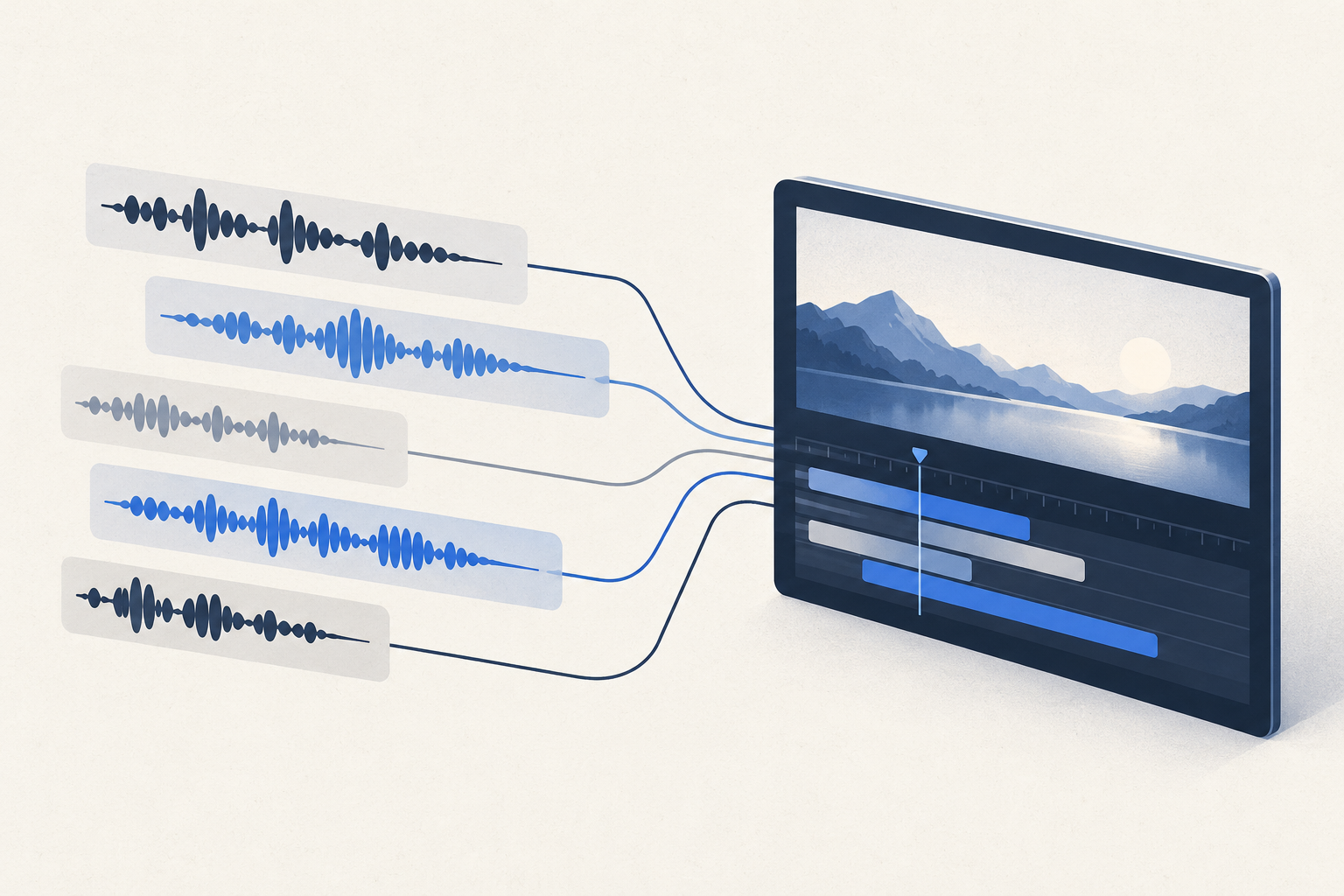
Compare the same passage before borrowing a timing rule
The first table compares each target configuration with US English for the same 200 source prompts. For each prompt & configuration, we took the median of its available recording lengths. We then divided the target median by the English median & expressed the difference from 1 as a percentage. Finally, we summarized those 200 paired changes. A prompt with 3 readings therefore received the same weight as one with 1.[2][4]
For the Latin American Spanish recordings, the median paired change was +24.8%. The middle half of prompt-level changes ran from +10.2% to +47.0%. For Japanese, the corresponding median was +36.6%, with a middle half from +17.8% to +61.8%. These describe the released recordings for matching passages; they do not prescribe how either language should be performed.
This differs from dividing 2 overall duration medians. Across the same common prompts, the median of the English prompt summaries was 9.3 seconds & the Spanish equivalent was 11.6 seconds. Dividing those displayed numbers would not reconstruct the paired +24.8% result. We matched each passage first, so the comparison keeps a short target passage beside its own English reference rather than beside a different passage near the middle of the distribution.
Dutch recordings had a median paired change of −6.1%, while Filipino recordings had +82.4%. Keeping both in the table makes the range of observed relationships visible. It also prevents the article from implying that every translated recording was longer. Within the common set, 71 Dutch prompt medians were longer than English, 2 were equal & the remainder were shorter.
Rows follow the fixed configuration order used in the analysis, rather than being sorted by the result. Read across the row relevant to your source comparison, then keep its research setting attached. Latin American Spanish & Filipino are the dataset’s source scopes; publishing this article in another language does not change those recordings into evidence about that market.
Paired recording-length change from US English
The same 200 translated source prompts in every row. Each prompt’s target median duration is divided by its English median; the change from 1 is expressed as a percentage. Q25 & Q75 bound the middle half of those paired changes.
| Target recording configuration | Median relative change (%) | 25th percentile change (%) | 75th percentile change (%) |
|---|---|---|---|
| Latin American Spanish | 24.8% | 10.2% | 47.0% |
| French (France) | 5.7% | -10.0% | 29.1% |
| German (Germany) | 31.4% | 0.0% | 62.4% |
| Dutch (Netherlands) | -6.1% | -21.6% | 8.9% |
| Indonesian (Indonesia) | 26.3% | 11.4% | 49.9% |
| Malay (Malaysia) | 11.3% | -1.2% | 29.1% |
| Filipino (Philippines) | 82.4% | 54.2% | 120.1% |
| Thai (Thailand) | 20.8% | 1.6% | 42.0% |
| Japanese (Japan) | 36.6% | 17.8% | 61.8% |
The spread matters when the job has one fixed clock
A median compresses 200 relationships into one number. A particular scene still has to accommodate a particular read. The quartiles beside each median show why carrying only the middle value into a brief would discard information relevant to that decision.
French recordings had a median paired change of +5.7%, but the middle half extended from −10.0% to +29.1%. A modest central difference coexisted with passages on both sides of the English clock. German recordings had a median change of +31.4%, with a middle half from approximately 0.0% to +62.4%. A displayed 0.0% is rounded; the unrounded lower quartile was slightly positive.
These intervals describe the middle half of the observed paired changes. They are not confidence intervals, minimum-to-maximum limits or a range that will contain a future commercial recording. The underlying passages, translations & performances differ from a new product script. Even an exact copy of the table’s median percentage would leave the production team without the actual take it needs to edit.
That distinction changes the question in a practical way. Instead of asking how much extra time a language always needs, a producer can ask whether the approved translated read fits the intended scene. The table explains why that check is useful; the recording for the job supplies the answer.
One passage can arrive with several recording clocks
Source prompt 1662 was chosen as the smallest ID available in all 10 configurations, before we summarized timing. Its table includes every available reading for that prompt. We did not search for a dramatic example after seeing the durations, & the prompt’s words or audio are not reproduced here.[3][4]
The 2 English files were approximately 8.4 & 11.2 seconds long, giving a median of 9.8 seconds. The 3 German files ranged from 10.4 to 23.5 seconds, with a median of 10.5. The 2 Filipino files ranged from 22.3 to 24.9 seconds, with a median of 23.6. These are complete-file clocks from the source metadata, rounded to 1 decimal place for display.
A median of 2 readings can be an arithmetic midpoint rather than the duration of a file someone actually recorded. The English 9.8-second display is such a summary. An editor selecting a take would still need to work with the chosen file’s own duration. The take count & minimum-to-maximum range make that distinction visible alongside the median.
The German spread also cautions against attributing every second to translation length. We have no speaker IDs & did not listen to the recordings or separate speech from pauses. Reading delivery, readers & recording conditions cannot be disentangled here. The example supports a simple production request: send the intended take, or a timed read of the intended wording, rather than a language-level estimate alone.
Prompt 1662: keep the take range beside the median
The smallest source ID with recordings in all 10 configurations, chosen from availability before timing summaries. All available takes are included. Seconds describe complete files in source metadata, with pauses unseparated.
| Recording configuration | Available takes | Shortest file (seconds) | Median file (seconds) | Longest file (seconds) |
|---|---|---|---|---|
| US English | 2 | 8.4 | 9.8 | 11.2 |
| Latin American Spanish | 3 | 8.8 | 9.5 | 9.5 |
| French (France) | 2 | 6.4 | 6.8 | 7.1 |
| German (Germany) | 3 | 10.4 | 10.5 | 23.5 |
| Dutch (Netherlands) | 1 | 7.9 | 7.9 | 7.9 |
| Indonesian (Indonesia) | 1 | 11.6 | 11.6 | 11.6 |
| Malay (Malaysia) | 2 | 8.0 | 8.6 | 9.1 |
| Filipino (Philippines) | 2 | 22.3 | 23.6 | 24.9 |
| Thai (Thailand) | 3 | 6.5 | 8.7 | 10.1 |
| Japanese (Japan) | 2 | 12.1 | 13.3 | 14.6 |
A 15-second example needs its denominator
We fixed 15 seconds as a planning illustration before calculating outcomes. It is not a platform requirement, a recommended ad length or a safe production allowance. The question was whether an English recording summary could fit within that clock while the corresponding target summary exceeded it.
Of the 200 common prompts, 186 had an English median of at most 15 seconds. Within that eligible group, the target median exceeded 15 seconds for 20 Latin American Spanish prompts, 39 German prompts, 9 Dutch prompts, 110 Filipino prompts & 37 Japanese prompts. Each count has the same denominator of 186; the other comparisons are retained in the download.[6]
We also used a stricter observed-take rule. Every available English reading had to fit within 15 seconds, & every available target reading had to exceed it. There were 178 eligible English prompts. This happened for 11 Spanish prompts, 9 German prompts, 4 Dutch prompts, 72 Filipino prompts & 14 Japanese prompts. These counts concern the released takes only, not every possible delivery of the passage.
The stricter check avoids relying on an arithmetic midpoint that nobody recorded. It still does not show that a passage cannot be read more quickly, edited differently or rewritten appropriately. For a team, the useful distinction is between evidence that a particular supplied recording fits & an assumption that another version will fit because English did.
A fictional launch shows where the handoff belongs
Consider an invented small kitchenware brand commissioning a 15-second product video from a creator. The concept has a demonstration, an offer & a closing product shot. Its English read takes 11 seconds. A translated draft is approved for meaning, but the intended narrator’s first read takes 17 seconds. The brand, script, timings & assignment in this example are fictional; they are not observations from FLEURS.
If the creator has already locked every shot to the English read, the 17-second file forces a decision late in the edit. The account lead can avoid leaving that choice implicit by asking for a timed read while the translated wording is still being reviewed. The brief should identify the message that must remain accurate, the available scene time & who can approve a change to either.
The response need not be to accelerate the narrator automatically. The translator might propose a shorter natural phrasing that preserves the offer. The editor might give the demonstration more time, move a secondary detail into accompanying copy or prepare a separate cut if the agreed format permits it. Those are production options to discuss, not improvements established by our corpus analysis.
A useful handoff for this fictional job could read: “Target version: __. Approved script: __. Intended take: __ seconds, measured from the supplied file. Scene allocation: __ seconds. Offer wording & required disclosures: __. Person approving script changes: __. Person approving the edit: __.” The blanks belong to the actual team; the research table cannot fill them.
With several target versions, the account lead can keep one row per intended take rather than mark the entire project “translation approved.” A wording approval & a timing approval answer different questions. If the translator changes a product claim after the scratch read, the row should identify that change before the creator reuses the earlier clock. This is a proposed way to organize the fictional assignment, not a tested reduction in project risk.
Once a revised take is supplied, the creator can review the complete version with the person responsible for language & meaning. A fit judged only from the duration can miss an awkward delivery or an unreadable closing frame. This study measured neither quality nor audience response. Its contribution to the fictional assignment is earlier knowledge of the recording clock, while the people making the video remain responsible for the creative choice.
Keep wording, take & picture together through review
For multilingual voice-over timing, the useful document is short enough to travel with the work. It identifies the approved script version, the intended recording & the scene clock. If one changes, the person receiving the next handoff can see which timing evidence still applies.
A timed scratch read can expose a conflict while the team still has choices. It should remain labeled as a scratch read, rather than being treated as proof that a final narrator will deliver the same duration. When the intended take arrives, replace the assumption with its measured clock & review it in the actual edit.
Keep the translated version intact during that review. The person checking meaning needs to hear the delivery alongside the picture, while the editor needs to see whether pauses, product reveals & the final frame work together. A file fitting a duration is one piece of evidence; it is not approval of everything in the version.
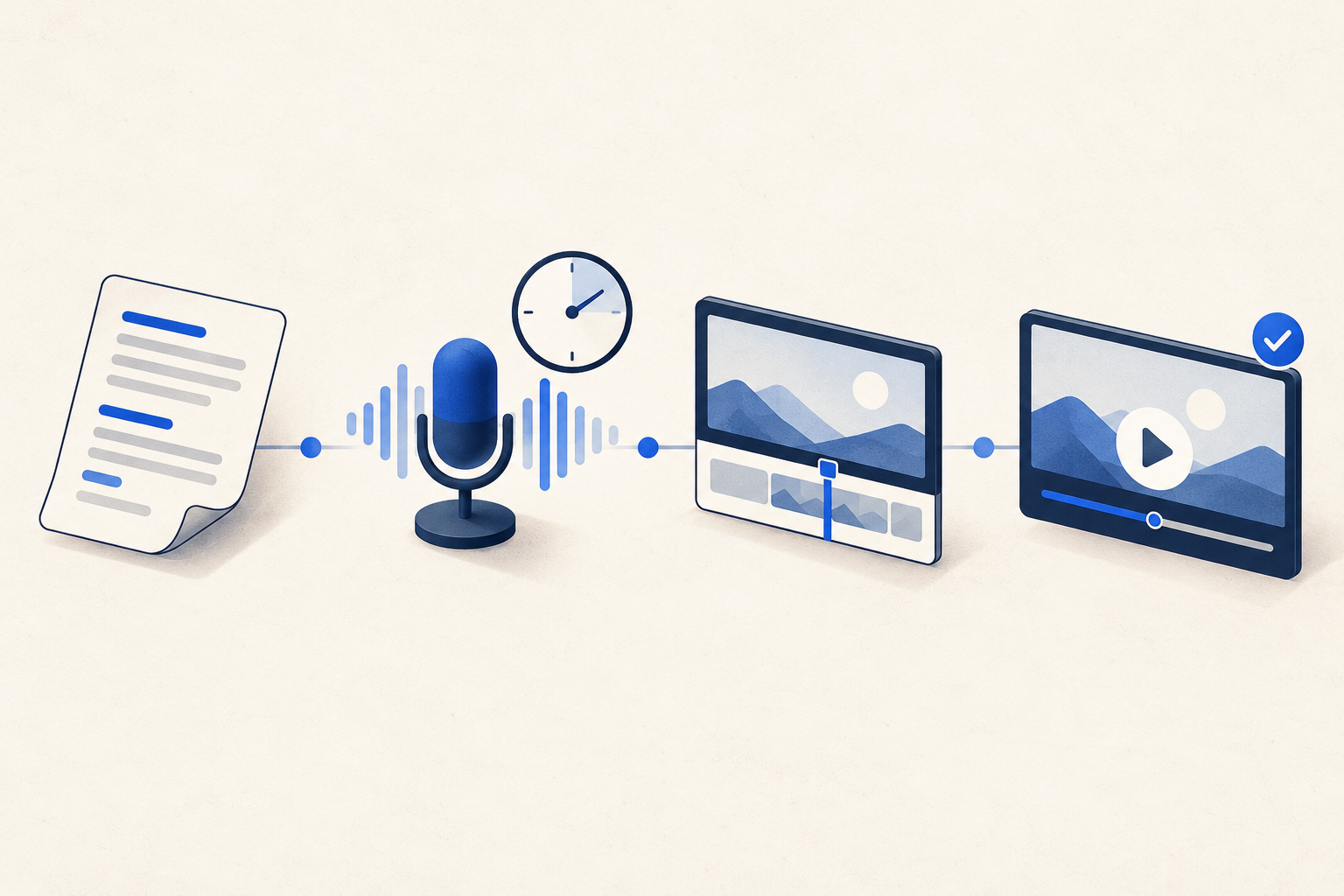
The 4 steps below are a suggested handoff, not a workflow tested in FLEURS. They apply the study’s distinction between wording & recorded duration to a production decision. They make no promise about reach, retention, conversions or how many revisions a project will require.
Carry the recording clock through 4 handoffs
Agree the wording
Identify the target version, approved script & person reviewing meaning.
Time the intended read
Attach the take’s measured duration; label a scratch read as provisional.
Resolve the fit
Agree any script or scene change before committing the edit.
Review the whole version
Check the chosen take with the picture, offer & closing frame.
Keep the matched set visible when reusing a number
The common comparison includes 200 of the 350 English test prompts. The remaining 150 lacked at least one selected configuration. Complete availability may be selective, so the common set should not be described as a random sample of scripts, languages or voice-over jobs.
We repeated each English–target comparison using every available matched pair. Those denominators ranged from 251 for Dutch to 349 for Filipino & Thai. We also repeated the common-set comparisons using only prompts with at least 2 English readings & 2 target readings; those subsets ranged from 66 to 166 prompts. All 9 paired results & their denominators are in the download.[4]
The repeated-reading subsets retained the same direction of median paired change as the main comparison in every configuration. That is a useful check on this particular summarization choice. It does not control the readers or make the different pairwise samples comparable populations. Repeated takes are not independent participants.
The acquired German, Dutch, Indonesian, Malay & Filipino recordings were all labeled male; Thai recordings were all labeled female. English, Spanish, French & Japanese had mixed labels. Without speaker identifiers, the analysis cannot separate configuration from reader composition, performance, translation or retention. Read the table as a description of these recordings, with that limitation beside any reused number.[7]
How the recording-clock comparison was made
FLEURS is a research corpus introduced in 2022 using translated read passages. The producer & TensorFlow Datasets documentation identify a shared source-text ID across languages & a metadata field for total audio frames at 16,000 Hz. We used that field divided by 16,000 as metadata-reported complete-file seconds. We did not decode audio, verify waveform lengths or remove silence.[1][2]
We acquired the 10 test metadata files at the fixed producer revision documented in the notes on October 24, 2026 (UTC). They contain 7,528 recordings across the available prompts. Matching used source IDs, never row position. The 200-prompt common set, 15-second rules, repeated-reading check & example 1662 were fixed after availability was known & before timing summaries were calculated.[3][4]
The acquisition date identifies the source snapshot we used. It does not turn recordings introduced with a 2022 research corpus into a 2026 survey of narrators or creators. The public data retain the source revision so a later reader can distinguish a new analysis of existing material from newly collected performances.
An earlier development-split feasibility attempt produced only 91 common prompts, below its 100-prompt threshold, & was set aside. The test acquisition initially stopped at a Thai metadata size cap; a documented larger cap completed the same fixed test frame. These are disclosed changes in feasibility & access, not evidence of an outcome-blind preregistered study.
All paired calculations used exact frame counts & fractions. Quartiles use linear interpolation at positions defined by (n−1) × p. Tables display percentages & seconds to 1 decimal using half-up rounding; take counts remain integers. The public derived data retain the exact prompt summaries, pairwise results, sensitivity checks & both clock definitions. We calculated no population confidence intervals or causal effects.[4]
Timing constraints in dubbing are already an established research subject.[5] This article adds a reproducible comparison of the released file clocks for these fixed passages, plus the information needed to inspect its coverage & repeated takes. It supports requesting timing evidence for a translated production before locking the edit; it does not supply a universal expansion percentage.
- Download the 67 displayed findings (CSV)
- Download all 350 prompts × 10 configurations & take summaries (CSV)
- Download all 9 paired comparisons, sensitivity checks & clock counts (CSV)
- Download the sources, method & reproduction code (ZIP)
No sign-up required. Derived data preserve missing combinations & actual comparison denominators. The shared package contains English method documentation, source references & reproduction code; no original transcripts or audio are redistributed. Every language edition describes the same fixed corpus.[8]
Research notes
- Conneau et al., FLEURS: Few-shot Learning Evaluation of Universal Representations of Speech (2022), sections 2.1–2.3. The corpus contains translated read passages with up to 3 validated recordings per sentence, sampled at 16 kHz. Its collection & research purpose do not establish representativeness for commercial voice-over production. Source passages trace to FLORES; they are not an advertising-script sample.
- TensorFlow Datasets, xtreme_s version 2 feature documentation & owning parser. The source-text ID is consistent across languages & can repeat across readings; num_samples records total audio frames. The audio feature declares 16,000 Hz. The parser copies metadata counts rather than checking them against decoded waveforms. Our seconds are metadata-reported whole-file durations, with pauses unseparated & no speaker-identity control.
- Google FLEURS metadata, fixed revision ab93cf03f9d0cd083c853fad065a6377067408aa, test split, acquired October 24, 2026 (UTC). Configurations: en_us, es_419, fr_fr, de_de, nl_nl, id_id, ms_my, fil_ph, th_th & ja_jp. The linked English TSV is one of the 10 source files; the package records every exact source URL & SHA256. Source Spanish is Latin American & fil_ph is Filipino.
- Influence IQ calculations: one within-prompt median per configuration; equal prompt weights; paired target-to-English median ratio & paired seconds difference. Primary support is the 200 prompts shared across all 10 configurations, from 350 English prompts. Secondary comparisons use all available English–target pairs & common prompts with at least 2 takes on each side. The method & example choice were fixed before timing summaries, after availability. Exact fractions, interpolation, rounding & all denominators are documented in the reproduction package.
- Dubbing in Practice: A Large-scale Study of Human Localization With Insights for Automatic Dubbing (2023). Prior work already examines timing in professional human dubbing. Our contribution is the finite paired FLEURS file-clock table & its reusable production-handoff interpretation, not discovery of dubbing timing constraints or a professional dubbing benchmark.
- The 15-second clock was fixed as a planning illustration before outcomes. Median rule: 186 common prompts have English median ≤15 seconds; count target medians >15. All-observed-takes rule: 178 have every English take ≤15; count prompts with every observed target take >15. Boundary equality fits the clock. Counts are descriptive released-recording results, not platform guidance or a claim about every possible reading.
- The acquired metadata have no speaker IDs. German, Dutch, Indonesian, Malay & Filipino recordings are all labeled male; Thai recordings are all labeled female. Missing configurations remove 150 of 350 English prompts from common support. Pairwise & repeated-reading checks describe different finite subsets & do not remove performer, gender, delivery, translation or retention confounding. No confidence intervals, language-speed ranking, causal effect or commercial forecast is reported.
- Source: Google FLEURS, provided under CC BY 4.0. Selection, calculations, tables, editorial interpretation & translations are adaptations by Influence IQ; no endorsement by the dataset authors is implied. The public package redistributes derived numeric summaries & code, not original audio or passage text. Display rounding does not change exact source counts or the shared recording population.
The English article is the source for all language versions. Every edition reports the same fixed FLEURS test recordings & translated passages; article language does not create evidence about a new market. Influence IQ is responsible for the analysis, interpretation & translations.