Measure podcast clips before normalizing them again
In a 72-clip case study, checking the existing export & repairing 9 clips reached the same delivery limits as normalizing all 72. The tradeoff included 9 extra exports.
We compared 72 fixed clips from 6 HPR programs published October 8–21, 2026, after normalizing each full episode in the lab.
Abstract
Should a creator normalize every podcast clip again after mastering the full episode? We compared 3 workflows on 72 fixed 15-, 30- & 60-second clips from 6 published HPR programs. Reusing the episode master produced 63 exports clearly within our loudness & true-peak limits, 7 definite failures & 2 boundary cases.
Both normalizing every cut & measuring existing exports before selective repair produced 72 final files within the limits. Selective repair required 9 normalizations & 81 exports; always normalizing required 72 normalizations & 72 exports. For selective repair, the summed per-window median native processing wall time was 64.0 seconds, compared with 108.6 seconds for always normalizing. This finite test supports a keep-or-repair decision on the final export; it does not estimate listener response or an editor’s complete production time.
You have finished a podcast episode & prepared its audio master. Now a publishing colleague needs short extracts. The episode’s loudness has already been set, but the new files contain only a small part of it. Should every cut go through normalization again, or can some exports keep the audio they inherited from the master?
We tested that decision with 3 actual workflows: reuse the master, normalize every cut, or measure each existing export & repair only the ones that did not clearly meet the chosen limits. The comparison included the checks & replacement exports required by each route, so avoiding a normalization pass did not count as a saving by itself.
Most exports in this batch could be kept. Nine needed repair under the chosen rule. Checking first produced the same number of final files within the limits as always normalizing, with fewer normalization operations but more exports. For a creator or small business, that is a choice about how to prepare & approve the files handed to the next person.
A full episode becomes several shorter files
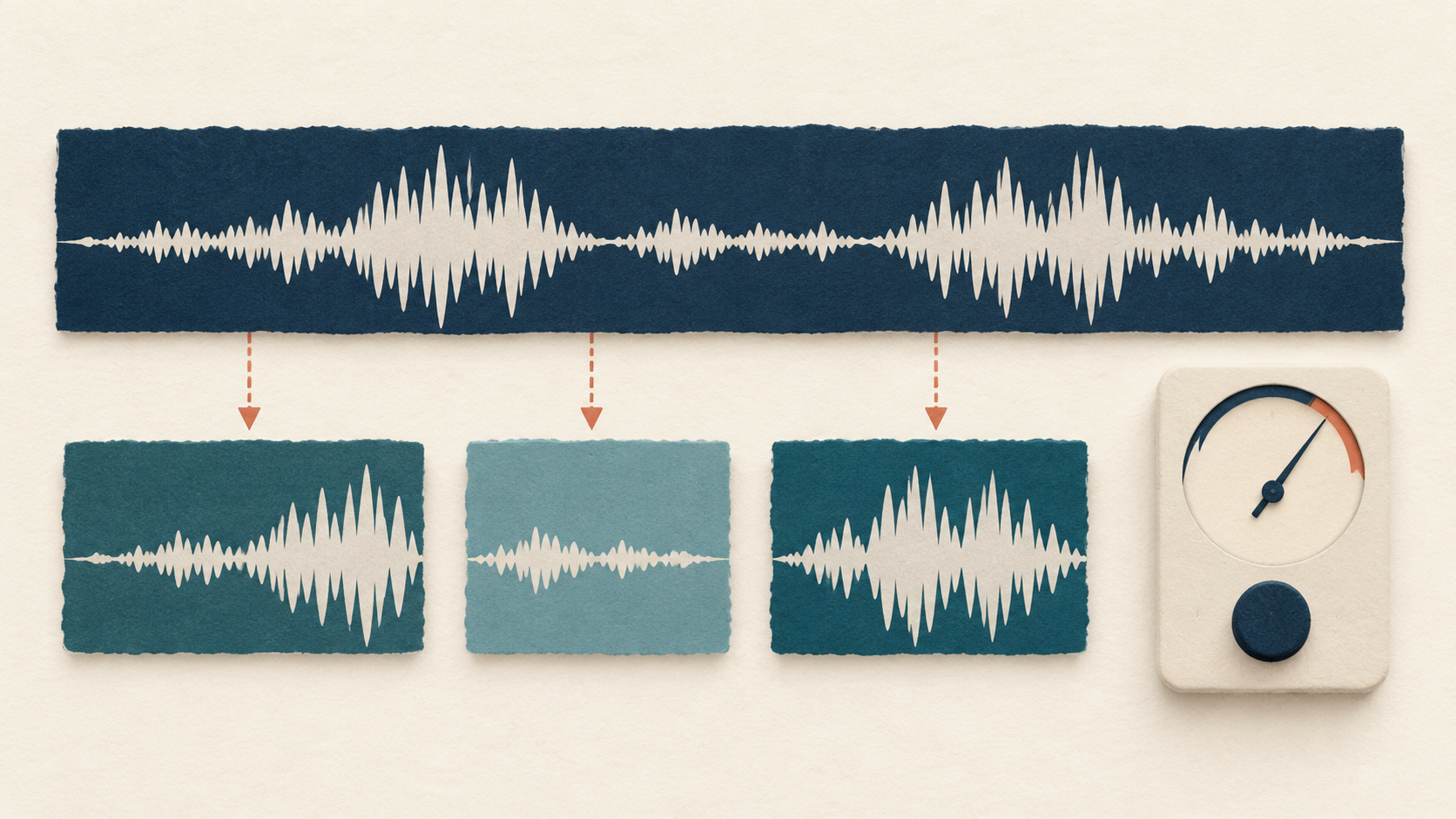
The finished export was the decision point
An episode can meet an overall loudness target while a short extract falls outside it. Integrated loudness summarizes the audio over the measured interval. Changing that interval changes what is being summarized. A quiet exchange, a louder passage or a pause can occupy a different share of a short clip than of the whole episode.
We used 2 delivery measurements. Integrated loudness, reported here in LUFS, describes the level across the clip under the meter’s weighting & gating rules. True peak estimates peaks between digital samples. Passing one check does not establish that the other passes, & neither is a listening assessment of speech clarity, noise or editing quality.
Our reference was Apple’s podcast recommendation: overall loudness around −16 with a tolerance of ±1, & true peak no higher than −1. Apple expresses the loudness recommendation in LKFS; our FFmpeg meter reports LUFS. We tested a delivery interval of −17 to −15 LUFS & a true-peak ceiling of −1 dBTP. These are the chosen limits for this comparison, not a requirement for every social platform.[3]
The full-episode processor aimed at −16 LUFS & −1.5 dBTP. We then made the same fixed cuts from that episode master for all 3 workflows. Each final file was stereo AAC at 192 kbps & 48 kHz in an M4A container. We measured the decoded export, so the result describes the file produced by the workflow rather than only the audio entering the encoder.
The reuse workflow exported each cut & checked it. The always-normalize workflow normalized every cut before exporting & checking it. The measure-then-repair workflow began with the reuse export, kept it when it passed, & repaired it otherwise. All 3 therefore included a final delivery check.
The final delivery outcome for the same 72 windows
Each workflow used all 72 fixed windows from the same episode masters. Counts describe distinct windows; timing repetitions are not additional clips.
| Workflow | Clear passes | Definite failures | Boundary cases |
|---|---|---|---|
| Reuse the master | 63 | 7 | 2 |
| Normalize every cut | 72 | 0 | 0 |
| Measure, then repair | 72 | 0 | 0 |
Nine repairs replaced 72 normalizations
Of the 72 exports made directly from the episode masters, 63 were clearly within both delivery limits. Another 7 were clearly outside at least one limit. The remaining 2 were too close to a boundary for the meter’s displayed precision to establish a clear pass or failure. We kept that third category visible rather than treating those files as confirmed failures.
The selective workflow repaired both the 7 definite failures & the 2 boundary cases. All 72 of its final exports met the conservative pass rule. Normalizing every cut also produced 72 final exports that met that rule. The difference was how much audio each workflow processed again: 9 cuts in the selective workflow, compared with all 72 in the always-normalize workflow.
That saving came with extra exports. Selective repair first produced 72 files, then replaced 9 of them, for 81 exports altogether. Always normalizing produced 72 exports. A creator deciding between them needs both numbers. Fewer normalization operations do not automatically mean fewer files written or less total processing.
For each repair, we returned to the original lossless cut from the episode master. We measured that cut for normalization, applied the second pass, exported a replacement AAC file & checked the replacement. We did not normalize an already encoded AAC file or use its measurements to set the gain on a different PCM input.
Checking first still had a processing cost
The selective workflow used less measured processing time than normalizing every clip, even after its extra exports & checks were included. The summed per-window median wall times were 52.3 seconds for reuse, 108.6 seconds for always normalizing & 64.0 seconds for measure-then-repair. CPU time followed the same order: 56.3, 120.1 & 69.3 seconds, respectively.
These totals include the required FFmpeg & ffprobe processes for each workflow: exporting, reading file properties, decoding for quality checks, scanning PCM for normalization & making any replacement export. In the selective workflow, the first export & check were charged even when the file later needed repair. The second export & check were charged as well.
Each window went through every workflow 3 times, with the execution order rotated. We took the median processing time for each window, then added those 72 medians. The table therefore shows a sum of per-window medians, not the elapsed time of one observed production batch. The 648 executions are timing repetitions of the same 72 windows across 3 workflows, not 648 different clips.
The measurements came from one Apple M4 computer using one worker. They cover native FFmpeg & ffprobe processing, including process startup. They exclude Python hashing & serialization, the shared preparation of the full episode masters & cuts, & any time a person spends choosing, reviewing or handing over clips. They are not estimates of an editor’s complete job time.
That scope changes the practical choice. A team whose export system already measures final files could use the result to decide which cuts need another normalization pass. A team that must open a separate tool & manage replacements by hand may face a different tradeoff. Our processing totals do not price that manual work or establish how another editor or device will perform.
Selective repair used fewer normalizations & more exports
Actual operations for one 72-window set; timing columns sum each window’s median across 3 executions on an Apple M4, using one worker.
| Workflow | Normalization operations | AAC exports | Native processing wall time (seconds) | Native processing CPU time (seconds) |
|---|---|---|---|---|
| Reuse the master | 0 | 72 | 52.3 | 56.3 |
| Normalize every cut | 72 | 72 | 108.6 | 120.1 |
| Measure, then repair | 9 | 81 | 64.0 | 69.3 |
The 15-second clips needed more repairs in this batch
Each duration had the same denominator: 24 windows, drawn from 4 positions in each of 6 programs. Reuse passed for 19 of the 15-second clips, 22 of the 30-second clips & 22 of the 60-second clips. The corresponding numbers sent for repair were 5, 2 & 2.
The reason for repair differed at the longer duration. All 5 of the 15-second cases & both 30-second cases were definite failures under the chosen limits. The 2 remaining 60-second cases were boundary cases. Treating those as repair candidates was a workflow choice made before the outcomes, not evidence that both were definitely outside the delivery interval.
The clips were nested around the same centers. A 15-second cut sat inside a 30-second cut, which sat inside a 60-second cut. These are related extracts of the same programs. The table describes this batch; it does not establish a general probability that a 15-second podcast clip will need repair.
All 9 repairs were concentrated in 2 programs: 4 in HPR Beer Garden 22 - Bitter & 5 in murph’s conference presentation. The other 4 programs supplied 12 passing reuse clips each. That concentration makes a single overall percentage a poor promise for the next episode. A team can encounter a batch with no repairs or one with several, even when the same export settings are used.
Five of the 24 shortest clips were sent for repair
Each duration includes 4 fixed centers from each of 6 programs. Longer windows surround the same centers, so these are related extracts.
| Clip duration | Windows tested | Clear reuse passes | Sent for repair |
|---|---|---|---|
| 15 seconds | 24 | 19 | 5 |
| 30 seconds | 24 | 22 | 2 |
| 60 seconds | 24 | 22 | 2 |
One presentation episode shows the handoff
The published episode “murph gives a presentation talk about Hacker Public Radio at the OLF conference” supplied 12 fixed cuts. HPR released it on October 15, 2026; its page describes a conference presentation made in December 2025. We used the complete published podcast asset, including its branding, then prepared the full-episode master used in this test.[6]
For those 12 cuts, the reuse workflow produced 7 clear passes, 4 definite failures & 1 boundary case. Under the selective rule, the 7 passing files were kept. The other 5 cuts returned to the lossless source for normalization & a replacement export. The final delivery set contained 12 passing files, reached through 5 normalization operations & 17 exports.
Always normalizing the same 12 cuts also produced 12 passing files, with 12 normalization operations & 12 exports. The selective route therefore avoided processing 7 cuts again, but it made 5 additional exports. This episode provides a concrete example of the exchange shown in the full-batch results, without assuming that normalization count alone measures the work.
For a creator or business handing that set to a publishing colleague, the useful completion note would identify the 12 final files, the delivery limits used & which 5 files replaced an earlier export. A folder containing both the original & repaired versions without a clear final selection creates a separate handoff problem that the loudness measurements cannot solve.
These counts concern our laboratory versions of the episode. They are not a judgment of the presenter, the original production or its suitability for listeners. We did not choose the cuts because of what was said or how they sounded. Their positions were fixed before any loudness outcomes were measured.
Check the file your colleague will publish
For an episode that has already been mastered, the first decision is the delivery specification for its clips. Agree on the loudness interval, peak ceiling, file format & intended destination before interpreting a pass label. If a client or platform uses a different specification, these counts do not transfer to that specification unchanged.
Then make the keep-or-repair decision on the exported file. In the tested selective workflow, the editor could retain any file that clearly met both limits. A definite failure or a result too close to the boundary triggered repair from the original lossless cut, followed by a replacement export & another check. This rule specifies what happens to an uncertain result instead of leaving it to an unexplained green light.
The final check belongs after the last change that affects the delivered audio. Adding an introduction, music, a fade or a new edit produces a different file from the one measured here. A result attached to an earlier version should not travel forward as if it described that later export. Keep the measurement with the actual file selected for delivery.
Keep the delivery note specific enough for the next person to use: the selected file, the loudness & peak values, the limits applied & the resulting status. A note that says only “normalized” names a processing step. It does not tell a publishing colleague whether the final encoded file was measured or whether it met the agreed limits.
The choice between selective & always-normalize processing also depends on the handoff. Selective repair was useful here because most existing exports could be retained & only 9 needed replacements. Always normalizing gave a simpler single-export path for every cut. Both reached the same measured delivery outcome in this batch, while arranging the processing differently.
A small team can choose the route its tools support cleanly. The evidence favors measuring before deciding that every cut needs another normalization pass. It does not establish that a person should spend several minutes managing files to save a few seconds of native processing. Keep the measured technical tradeoff separate from the editorial work that still needs to happen.
Three routes from an episode cut to a checked export
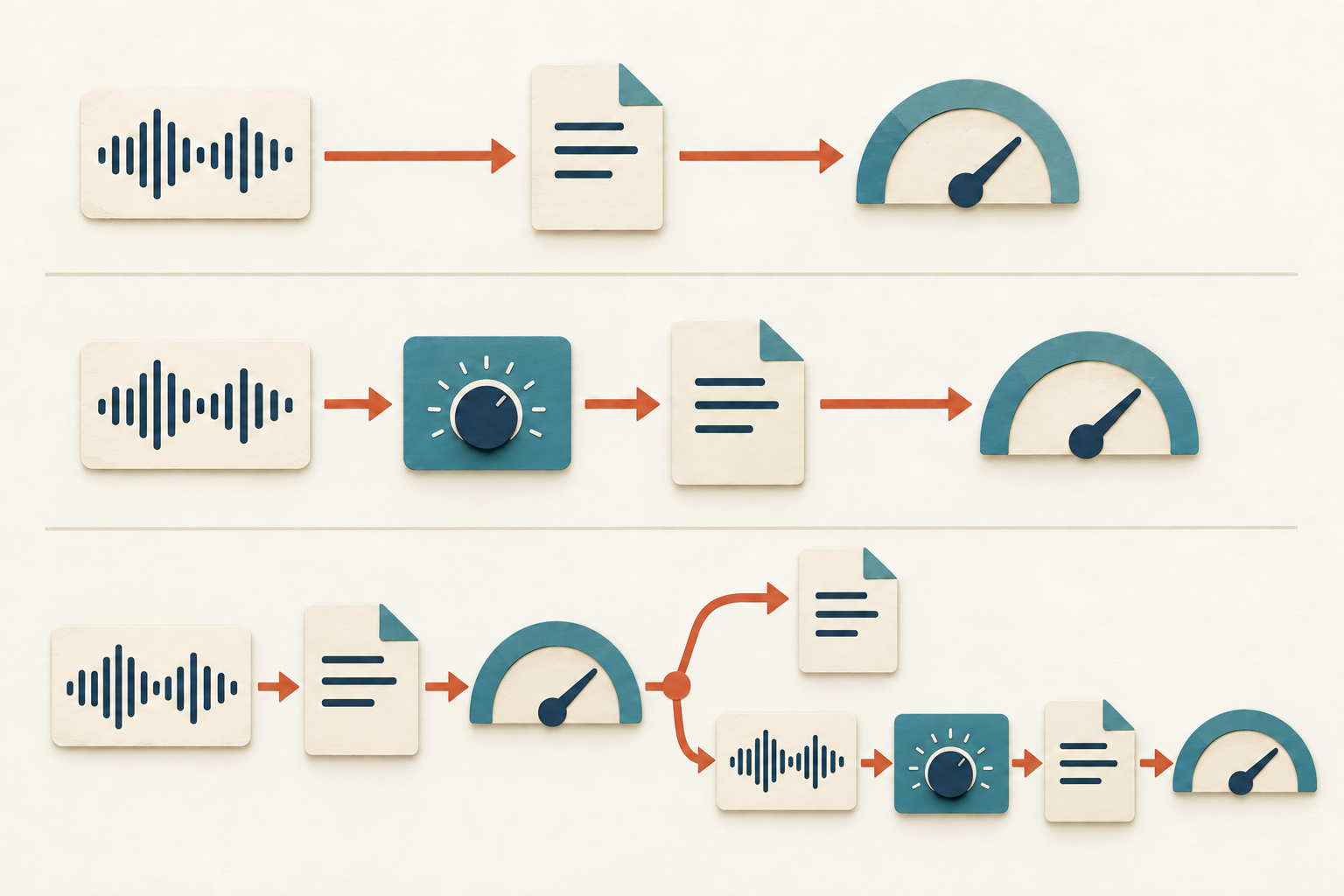
Reuse the master
Export the original cut, then measure the final file.
Normalize every cut
Measure the PCM cut, normalize it, export it & check the final file.
Measure, then repair
Check the existing export. Keep clear passes; return to the original PCM cut for other cases, normalize, re-export & check again.
How the 72 clips were compared
We selected the 6 latest complete HPR programs published strictly before October 23, 2026 whose producer-page durations were between 20 & 60 minutes. Their publication dates ran from October 8 through October 21. Eligibility was fixed from metadata before audio outcomes. We retained the complete published branded assets & recorded their actual decoded durations separately from the page durations.[1][2]
This is a case study of one community technology podcast, not a representative sample of podcasts or creators. Two selected programs were successive Beer Garden panels with recurring participants. The published sources had already undergone production whose details we did not reconstruct. Our whole-episode normalization was an additional laboratory step, not a simulation of raw microphone recordings.
We prepared each complete episode with FFmpeg 8.1.2 two-pass loudnorm, targeting −16 LUFS & −1.5 dBTP, then retained a 48 kHz stereo PCM master. LRA was set to 50 so the default 7-LU setting would not impose that separate target; loudness range was not a short-clip outcome. The actual linear or dynamic normalization mode was retained in the operation records.[4]
For every program, we placed clip centers at exactly 20%, 40%, 60% & 80% of its decoded sample count. At each center we cut nested 15-, 30- & 60-second windows, giving 12 windows per program & 72 overall. All workflows used those same cuts from the same masters. The positions were not selected for speakers, content, silence or measured loudness.
Final ratings used the native ebur128 meter on the decoded AAC presentation. We accounted for AAC priming & tail padding so each measurement covered the intended number of samples. The meter’s final summary displays integrated loudness & true peak to 0.1. We allowed for that display rounding by treating each value as an interval extending 0.05 in either direction; this is a rounding allowance, not a claim about measurement accuracy.[5]
A pass required the whole loudness rounding interval to lie within −17 to −15 LUFS & the peak interval’s upper end to be no higher than −1 dBTP. A definite failure lay clearly outside at least one limit; the remaining cases were labeled boundary & repaired by the selective workflow. The shared download provides the per-window technical results, processing definitions, calculation code & meter reconciliation. No source or derivative audio is redistributed.[7]
- Download the displayed findings (CSV)
- Download technical results, definitions & calculation code (ZIP)
No sign-up required. The shared ZIP contains technical measurements & English calculation instructions. Article text, figure labels & the displayed-results CSV are localized. The package reproduces the reported calculations from supplied measurements, rather than rerunning the complete audio pipeline. No source or derivative audio is included.
Sources & notes
- Hacker Public Radio episode archive. Selected programs: hpr4753, HPR Beer Garden 22 - Bitter, Kevie, October 21; hpr4749, murph’s OLF presentation, murph, October 15; hpr4748, Programmable Logic Controls - Episode 5, Whiskeyjack, October 14; hpr4747, UNIX Curio #13 - Replacements for cat, Vance, October 13; hpr4745, BruCON interview 1: The BruCON organization, Kristoff, October 9; hpr4744, HPR Beer Garden 21 - Mild, Kevie, October 8. All dates 2026. Individual episode links & asset identifiers are included in the analysis package.
- Hacker Public Radio contribution policy. The producer describes its publishing transformations, including format conversion & automatic introduction/outro, & specifies Creative Commons Attribution-ShareAlike 4.0 for shows. This study analyzes complete published assets. It redistributes neither those assets nor derived clips.
- Apple Podcasts for Creators, Audio requirements, Audio levels. Recommends overall loudness around −16 dB LKFS with a ±1 dB tolerance & true peak no higher than −1 dB FS, with preconditioning before encoding. This supplies the podcast reference used here, not a universal social-platform delivery specification.
- FFmpeg 8.1.2 filter documentation, loudnorm. Describes single-/double-pass & linear/dynamic normalization. The experiment used native FFmpeg 8.1.2 with the settings & actual operation modes retained in the package.
- FFmpeg 8.1.2 ebur128 source, final summary formatting. Integrated loudness & true peak are displayed to 1 decimal place. The study’s conservative 3-way rule handles this display precision; it is not a certified-meter accuracy claim. Final delivery ratings are separate from the normalizer’s own input/output statistics.
- HPR episode hpr4749, murph gives a presentation talk about Hacker Public Radio at the OLF conference. Host murph; published October 15, 2026. The source page describes the presentation as taking place in December 2025. Episode title & publication date identify the source, not an assessment of its original audio production.
- Influence IQ calculation package. Contains aggregate & per-window technical measurements, source attribution, fixed selection/window rules, native processing-time definitions, calculation code & meter reconciliation. It reproduces the reported calculations from supplied measurements; it is not a portable package for rerunning the complete audio-processing pipeline. No raw or derived audio, speech text or private operating records are included.
Every language edition describes the same 6-program HPR case study. Translation does not create findings for another country, podcast population or social platform.