One creator, three platforms: do the social media handles match?
In a study of 1,667 wellness creator entries with Instagram, TikTok and YouTube handles, 60.3% had at least one different handle. The practical lesson for brands is to collect each platform link, even when two names already match.
Original analysis of Pew Research Center’s May 2026 public creator-handle file, collected in 2025 and early 2026.
Abstract
A creator’s social media handles do not necessarily match across platforms. We analyzed Pew Research Center’s public list of U.S.-facing, primarily English-language wellness creators. Among 1,667 eligible entries with one handle recorded for each of Instagram, TikTok and YouTube, 661 (39.7%) had the same handle on all three after we ignored capitalization and a leading @. Another 711 (42.7%) matched on exactly two platforms, while 295 (17.7%) differed on all three.[1]
The result makes a simple brand workflow more concrete: collect an explicit profile link for every platform in a creator partnership. The analysis compares strings in a dated, source-matched creator list. It does not measure failed searches, audience recognition or the performance of influencer-discovery tools. The findings describe this selected, mainly large-account wellness group, rather than creators in every industry.
Imagine a campaign manager adding a creator to a brief. The creator’s Instagram and TikTok usernames match, so the manager fills in the same name beside YouTube. It is an easy shortcut. It also leaves one important detail unchecked: whether that third account uses the same handle.
Our analysis starts after the accounts have already been connected by the source researchers. Pew used profile links, link-in-bio pages and information from Modash to associate accounts with creators. That lets us ask a narrower question: within those established entries, how often does one spelling work across the recorded platforms?[2]
A social media handle is the account’s username, commonly shown with an @. It is different from a display name. Here, “matching” means the recorded usernames match after the small formatting adjustments described below. It does not mean that identical usernames, by themselves, prove two accounts belong to the same creator.
One creator can have several account names
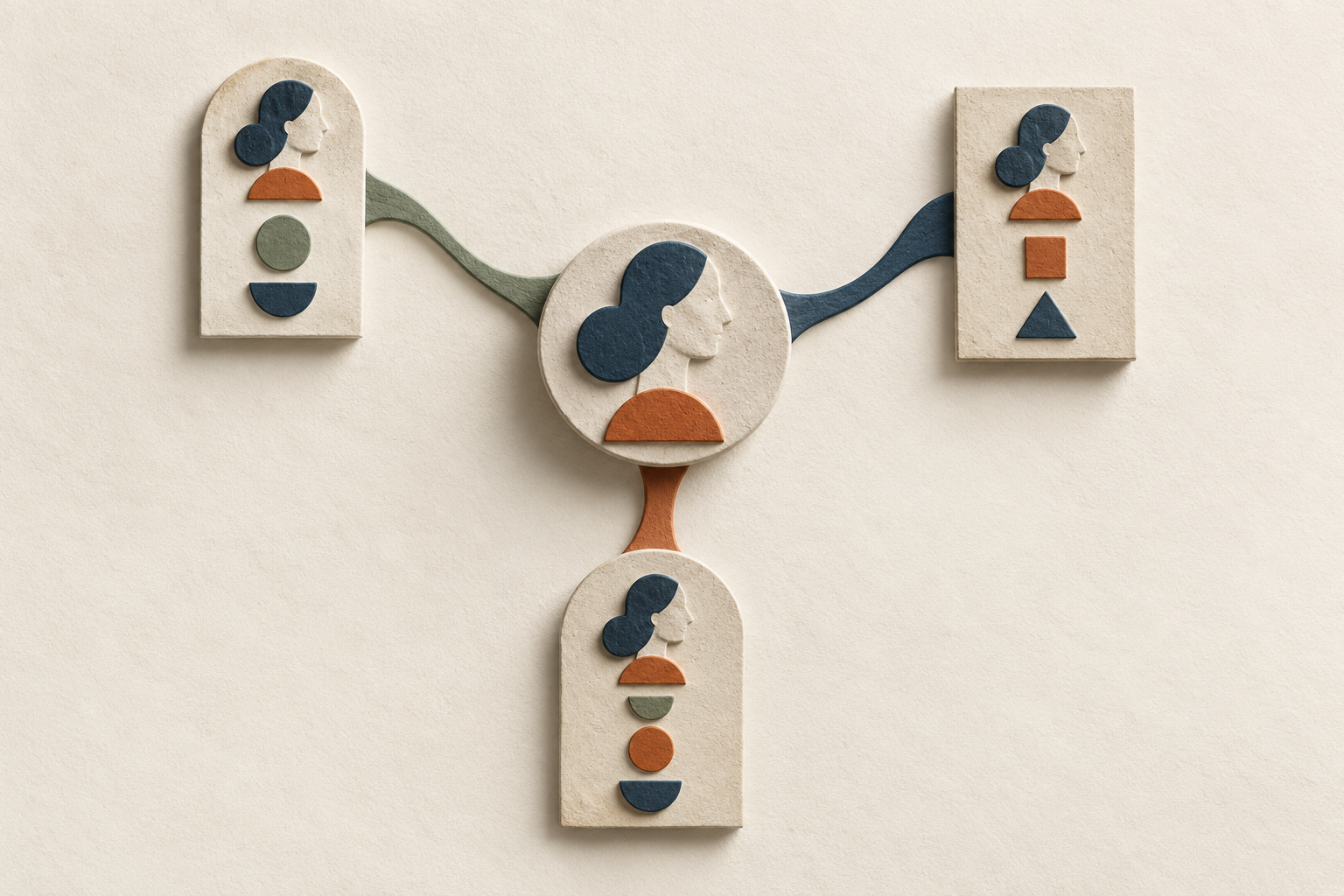
- One creator entry
- Separate platform handles
Most three-platform entries had a difference
Of the 1,667 entries with one recorded handle on all three platforms, 1,006 had at least one difference. That is 60.3% of the complete three-platform group. The largest individual category was a match across all three, but it represented less than half of the group.
The other entries followed several patterns. Some shared an Instagram and TikTok handle while using another on YouTube. Others matched Instagram with YouTube, or TikTok with YouTube. A smaller group used three different strings. Keeping those patterns separate gives a more useful picture than a single “consistent or inconsistent” label.
How the three recorded handles fit together
Matching on all three was the largest single category. Together, the other patterns accounted for 60.3% of complete entries.
| Handle pattern | Creator entries | Share of complete entries |
|---|---|---|
| Same on all three | 661 | 39.7% |
| Only Instagram and TikTok match | 388 | 23.3% |
| Only Instagram and YouTube match | 151 | 9.1% |
| Only TikTok and YouTube match | 172 | 10.3% |
| Different on all three | 295 | 17.7% |
The chart describes names, not the quality of anyone’s branding. A different handle could reflect an earlier account, a separate creative identity or a name that was unavailable when the account was opened. The file does not identify those reasons, so none is assigned here.
For a brand, the immediate decision is smaller than asking a creator to rename accounts. Keep the actual destination for each part of the campaign. A useful partner record should still work when the three handles differ.
Two matching handles leave the third open
Exactly two handles matched in 711 of the 1,667 complete entries. The most common two-platform match was Instagram and TikTok, with a different YouTube handle: 388 entries, or 23.3% of the complete group.
That pattern matters when a team builds its creator list one platform at a time. Confirming a second matching handle does not settle the third. In this group, there were also 151 entries where only Instagram and YouTube matched, and 172 where only TikTok and YouTube matched.
Consider an invented example: a creator uses “willowstudio” on Instagram and TikTok, and “willowstudiofilms” on YouTube. A campaign brief that stores only the first name does not describe all three destinations. A brief with separate, creator-confirmed links does. These names illustrate the workflow; they are not examples from the dataset or links to real accounts.
The same distinction applies when handing work from a partnerships manager to a social editor. A familiar name can be enough for a conversation, while an exact profile link is more useful for preparing a tag or checking the agreed publishing account. The study counts how often names differ; the handover practice is our operational recommendation.
Keep each platform link in the partner record

Collect
Ask for the profile link for each platform included in the campaign.
Confirm
Check the intended account with the creator instead of copying another platform’s handle.
Keep together
Store the distinct links, platform names and confirmation date in the same partner record.
The platform pairs tell different stories
We also compared every eligible entry with both handles recorded for a given pair. Instagram and TikTok differed in 1,087 of 3,007 entries, or 36.1%. Instagram and YouTube differed in 1,370 of 2,562, or 53.5%. TikTok and YouTube differed in 922 of 1,819, or 50.7%.
Those denominators are different because the file does not record every platform for every creator. A blank cell means no handle was recorded there. It does not establish that the creator had no account on that platform.
How often a pair had different handles
Each row uses every eligible entry with both handles recorded for that platform pair.
| Platform pair | Entries with both handles | Different handles | Share with different handles |
|---|---|---|---|
| Instagram and TikTok | 3,007 | 1,087 | 36.1% |
| Instagram and YouTube | 2,562 | 1,370 | 53.5% |
| TikTok and YouTube | 1,819 | 922 | 50.7% |
To check whether the difference was simply a consequence of comparing different groups, we repeated all three pair comparisons inside the same 1,667 complete entries. Instagram and TikTok differed for 37.1%, Instagram and YouTube for 51.3%, and TikTok and YouTube for 50.0%. The broad pattern remained.
This comparison keeps the creator entries constant. It still does not tell us why YouTube-related pairs differed more often, or whether the platforms caused those choices. For a team that has collected an Instagram username, the practical implication is to confirm the YouTube link separately rather than copy the spelling into another column.
Compare the pairs within the same creator group
All three rows below use the same 1,667 complete entries.
| Platform pair | Same complete group | Different handles | Share with different handles |
|---|---|---|---|
| Instagram and TikTok | 1,667 | 618 | 37.1% |
| Instagram and YouTube | 1,667 | 855 | 51.3% |
| TikTok and YouTube | 1,667 | 834 | 50.0% |
Capitalization changes the answer
A spreadsheet can treat “WillowStudio” and “willowstudio” as different strings even when the difference is only capitalization. Counting that as a different practical handle would exaggerate the finding. YouTube’s own guidance says its handles are not case-sensitive.[3]
In the Instagram–YouTube comparison, a raw, case-sensitive check found different strings in 77.2% of the eligible entries. Removing a leading @ where present and ignoring capitalization reduced that to 53.5%. For TikTok–YouTube, the corresponding change was from 74.8% to 50.7%. Instagram–TikTok stayed at 36.1%.
The main results use the adjusted comparison. Punctuation and numbers remain meaningful: “willow.studio” and “willowstudio” are still different strings. We did not strip dots, remove suffixes, guess misspellings or search for additional accounts.
A case-sensitive check counts many more differences
The main comparison ignores capitalization and the leading @ symbol. It preserves punctuation and digits.
| Platform pair | Raw, case-sensitive | Without @, case-sensitive | Main comparison |
|---|---|---|---|
| Instagram and TikTok | 36.1% | 36.1% | 36.1% |
| Instagram and YouTube | 77.2% | 77.0% | 53.5% |
| TikTok and YouTube | 74.8% | 74.6% | 50.7% |
This is useful when reviewing an existing creator spreadsheet. A formatting difference and a different username need different attention. Preserve the supplied profile link and the original spelling; use a separate comparison field if you want to flag records for review. A normalized name can help organize a list, but it is not a substitute for the creator’s confirmed account.
Build a useful creator account record
The findings support separating the creator from the accounts listed for the campaign. Start with the name your team uses for the partnership, then give each agreed platform its own profile-link field. Store the username beside the link for convenience, with the date it was confirmed and who confirmed it.
For the invented Willow Studio partnership, the record would contain three separately supplied links and three platform labels. The Instagram and TikTok username fields could both say “willowstudio”; the YouTube field could say “willowstudiofilms”. The manager would leave any unconfirmed destination blank and mark it as needing confirmation. A blank should not be filled by guessing from another platform.
A concise request to the creator could read: “Please send the profile link for each account included in this campaign. If you use a different username on another platform, include that link too. Let us know if any account changes before the post goes live.” This is a suggested message, not a tested intervention or a quotation from the research.
Keep account confirmation separate from campaign approval. A correct link does not establish whether a proposed post meets the brief, includes the required disclosure or has been approved for publication. Those responsibilities belong in the campaign handover as separate decisions.
For an agency maintaining many partnerships, the first improvement can be a small change to the existing intake form: require platform-specific links only for accounts actually in scope. There is no need to collect every account a creator might own. The goal is a complete record for the work being commissioned.
What creators can make easier to find
For creators, the data are a reason to make account relationships clear, not a reason to abandon an established username. If your handles differ, you can give a prospective partner a short list of the profiles you want associated with the work. A media kit or maintained link page can carry those destinations in one place.
Pew’s researchers themselves used direct profile links and selected link-in-bio services as part of their account-matching process.[2] That explains how the source connected some differently named accounts. It does not show that every link page is complete, or measure how well a particular service helps a brand find you.
Before changing a handle to make it match elsewhere, consider the links already in circulation. TikTok says changing a username also changes its profile link.[4] A renaming decision therefore deserves a check of the places where you have shared that address. Our study did not compare the costs or benefits of renaming.
A practical starting point is to review the links you already send to partners. Do they open the intended profiles? Are the platforms labeled clearly? If one account uses a different name, is that easy to understand without another email? These questions address the actual handover, regardless of whether you choose one name or several.
How we made the comparison
We downloaded the public creator-handle CSV accompanying Pew Research Center’s May 7, 2026 report. Pew collected the initial accounts in September–October 2025 and added or consolidated accounts in January 2026. Pew mainly searched for accounts with at least 100,000 followers on one platform, posting primarily in English for a U.S. audience, and added a small supplement of prominent podcast hosts. It was not a random sample of all creators.[1][2]
The file contained 6,828 creator entries. We removed no exact duplicate rows. Before comparing handles, we excluded 100 entries that contained multiple comma-separated handles for at least one platform. This avoided selecting an arbitrary account. The remaining 6,728 entries had at most one recorded handle per platform; 1,667 had all three.
The excluded entries represented 1.5% of the source rows and 2.4%–2.7% of the potentially usable pair or three-platform groups. Each was below the 5% coverage threshold set before equality calculations. Entries missing a platform were included in other eligible pair comparisons, while the five-pattern comparison required all three handles.
Which entries remained in each comparison?
We excluded a source entry if any platform field contained more than one handle.
| Comparison group | Potentially usable entries | Excluded entries | Retained entries | Excluded share |
|---|---|---|---|---|
| All source entries | 6,828 | 100 | 6,728 | 1.5% |
| Instagram and TikTok | 3,082 | 75 | 3,007 | 2.4% |
| Instagram and YouTube | 2,628 | 66 | 2,562 | 2.5% |
| TikTok and YouTube | 1,866 | 47 | 1,819 | 2.5% |
| All three platforms | 1,713 | 46 | 1,667 | 2.7% |
The main comparison trims surrounding whitespace, removes one leading @, applies Unicode canonical normalization and converts ASCII capital letters to lowercase. It preserves punctuation, digits and accents. All observed handle strings in the file were ASCII. A separate full Unicode case-folding check produced the same aggregate results. The downloads also include the raw and wrapper-cleaned case-sensitive comparisons.
We retained Pew’s creator associations and did not look up accounts or join entries by similar names. The analysis therefore inherits the source’s account-matching and classification limits. Accounts or links not found during collection can be missing, and the released list is not a current directory. A creator entry can represent more than one person.
The public CSV contains 2,908 YouTube handle strings when its comma-separated values are counted, two fewer than the report’s stated 2,910 YouTube accounts. The reason is not established. Our calculations use the released file and the eligibility rules above, rather than reconstructing the report’s full account inventory.
We report descriptive counts and percentages for this fixed file, without population confidence intervals or causal estimates. The methods and code are available below; the source file must be obtained from Pew. We publish aggregate tables, not names, handles or individual profile records.[5]
- Download the aggregate handle comparisons and coverage counts (CSV)
- Download the methods, analysis code and reproduction instructions (ZIP; English instructions)
The English CSV includes every planned comparison and formatting check. The ZIP contains aggregate data, methods and code. Download the source file separately from Pew; no individual creator records are republished.
Sources and notes
- Pew Research Center, Moms, Coaches, Doctors, Entrepreneurs: Who Are America’s Health and Wellness Influencers?, May 7, 2026. Influence IQ’s handle comparison is an original analysis of the accompanying public file; it is not a Pew finding or endorsement.
- Pew Research Center, Methodology, May 7, 2026. Describes account selection, classification, profile-link and microsite collection, and account consolidation. The public handle CSV is linked from this page.
- YouTube Help, Learn about YouTube handles, accessed October 18, 2026. Handles differ from channel names and are not case-sensitive. This platform guidance supports treating capitalization separately; it does not establish cross-platform identity.
- TikTok Support, Changing your username, accessed October 18, 2026. TikTok distinguishes usernames from nicknames and states that changing a username changes its profile link.
- Influence IQ analysis package. Contains aggregate results, source-file identification, methods and reproducible comparison code. It excludes the raw creator file and individual account identifiers.
All language editions describe the same U.S.-facing, primarily English-language wellness creator group collected in 2025 and early 2026. These are not estimates for every creator or for readers’ local markets.