Multi-location marketing: how website and social links connect
A shared social link can accompany many website choices. The reverse also occurs. A comparison of ten location-data exports shows why a campaign brief should keep each record connected to both destinations.
Influence IQ analysis of ten selected AllThePlaces producer exports collected 10–13 October 2026. The URL-based comparison covers 3,843 records with both website and Facebook links; source references are export identifiers, not verified physical locations.
Abstract
For a multi-location campaign, keep each record connected to both its website and social link, even when a link repeats. We compared supplied links on the same source references in ten selected AllThePlaces producer exports collected 10–13 October 2026. Among 3,843 records with both website and Facebook URLs, the Staples export contains one Facebook URL paired with 1,758 different website URLs. Lush shows the reverse direction: 13 website URLs accompany 408 different Facebook URLs. Seven producers have a one-to-one pattern throughout their paired records. [1]
The comparison concerns supplied strings and export identifiers, rather than verified pages, accounts or physical locations. Only Facebook has URL pairs in these files; Instagram and Twitter literal tokens are reported separately. The ten exports contain 15,797 resolved records, so incomplete pairs remain visible in the coverage table. The practical implication is to retain each reference’s website/social association and intended campaign scope when approving destinations, even when a link is stored only once.
A creator has the local offer, the artwork and a list of links. Before a post can be approved, someone still has to connect the intended location with the right entries in that list. If several records share a social link, does that mean they should also share a website destination?
The supplied links do not always group the same way. In these exports, some records have a separate link on both sides. Others share a Facebook link while retaining different website URLs, or share a website while retaining different Facebook URLs. Keeping those associations visible gives the person preparing the brief a clearer choice.
The connection can run in either direction
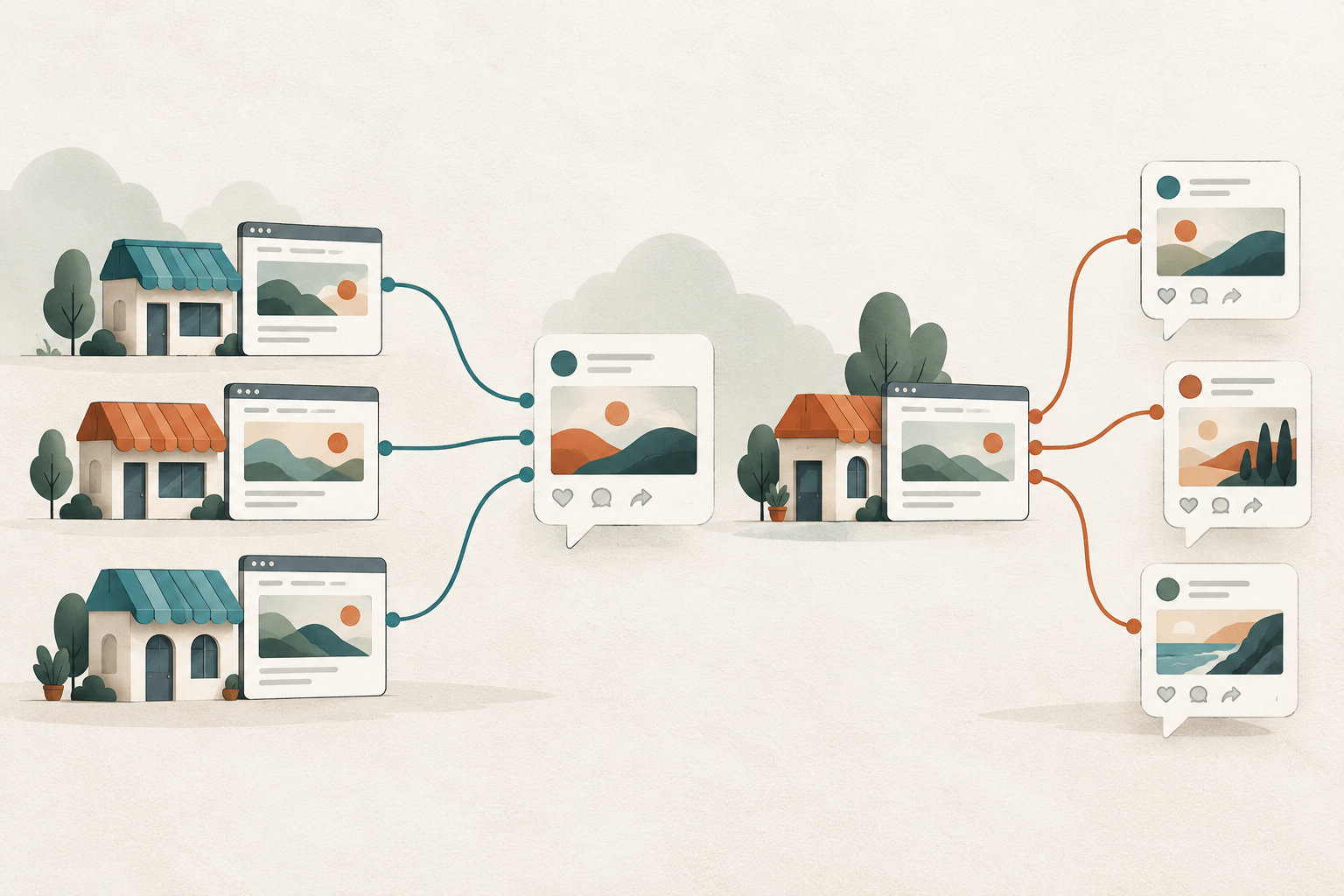
Start with the records that contain both links
The comparison begins with a source reference: the identifier attached to a record in an export. We keep that identifier together with the producer that supplied it. A producer is an AllThePlaces data collector, not necessarily one brand. For example, the Bravo export can include multiple brands, while the OZK export includes bank and ATM records. [1]
Across the ten exports, 3,843 records contained both a usable website URL and a usable Facebook URL. We compared those two fields on the same records within each producer. The other social fields contained literal strings rather than URLs, so their results appear separately later in the article.
The table shows how different that relationship can look. Arcaplanet has 484 paired records, 484 different website URLs and 484 different Facebook URLs. AutoZone has 692 of each. Bravo, J.Crew, Madewell, PetSuites and Coffee Bean also have a separate website and Facebook URL for every record in their paired sets.
Seven of the ten producers therefore have a straightforward one-to-one pattern in this comparison. A team retaining the original pairs can carry that relationship into its brief without inventing an extra grouping. These cases are part of the finding, alongside the more concentrated patterns in Staples, Lush and OZK.
Here, “different” means different supplied URL strings under our conservative comparison rules. We preserve paths, queries and fragments; we do not visit the destinations or merge links because they might open the same page. The counts describe a link inventory, rather than verified separate pages or accounts. [2]
Website and Facebook links group differently across the ten exports
AllThePlaces files collected 10–13 October 2026. Each row uses only records containing both a website URL and a Facebook URL; different links are different supplied URL strings under the fixed comparison rules.
| Producer export | Records with both URLs | Different website URLs | Different Facebook URLs |
|---|---|---|---|
| Arcaplanet | 484 | 484 | 484 |
| AutoZone | 692 | 692 | 692 |
| Bravo | 7 | 7 | 7 |
| J.Crew | 69 | 69 | 69 |
| Lush | 408 | 13 | 408 |
| Madewell | 24 | 24 | 24 |
| OZK | 242 | 2 | 242 |
| PetSuites | 93 | 93 | 93 |
| Staples | 1,804 | 1,804 | 47 |
| The Coffee Bean & Tea Leaf | 20 | 20 | 20 |
Keep incomplete records in view
The 3,843 pairs come from 15,797 resolved source records. A paired comparison answers a question about records with both fields; it is not a complete account of everything the exports supplied. Across the ten files, 9,174 records have a website URL without a Facebook URL, eight have Facebook without a website, and 2,772 have neither. [4]
Coverage varies substantially. PetSuites supplies both URLs on 93 of 94 records. AutoZone supplies both on 692 of 7,400, even though all 7,400 have a website URL. Staples supplies both on 1,804 of 5,425; 2,727 of its records have neither of these two fields. Keeping the source total beside the paired total makes these differences visible.
The counts below are records containing each field, so the website and Facebook columns overlap. They are not counts of different destinations, and they should not be added together as if they were separate groups. The earlier mapping table counts different links only within its paired records.
A missing field in this source is a follow-up item, not evidence that a business has no website or social presence. The collection process can affect what survives into an export. Current AutoZone code removes certain social values, and later enrichment can add missing values. Current code helps explain why source omissions need care, but we cannot establish which code revision produced every historical field. [5]
For a working campaign sheet, keep incomplete records in a separate review queue with their references intact. Record which field needs checking and who will resolve it. This prevents an incomplete pair from silently disappearing when someone prepares the shortlist, while leaving the decision about its eventual destination to a current review.
The paired comparison covers part of each source export
Records in the ten selected AllThePlaces exports, collected 10–13 October 2026. Every field count uses all resolved references for that producer, including records that cannot enter the paired website/Facebook comparison.
| Producer export | All resolved source records | Records with a website URL | Records with a Facebook URL | Records with both URLs |
|---|---|---|---|---|
| Arcaplanet | 626 | 626 | 484 | 484 |
| AutoZone | 7,400 | 7,400 | 692 | 692 |
| Bravo | 250 | 241 | 7 | 7 |
| J.Crew | 693 | 658 | 76 | 69 |
| Lush | 678 | 676 | 408 | 408 |
| Madewell | 162 | 159 | 25 | 24 |
| OZK | 275 | 274 | 242 | 242 |
| PetSuites | 94 | 94 | 93 | 93 |
| Staples | 5,425 | 2,698 | 1,804 | 1,804 |
| The Coffee Bean & Tea Leaf | 194 | 191 | 20 | 20 |
Keep a supplied handle-like value separate from a URL
The Instagram and Twitter fields require a different reading. In these ten exports, their nonempty usable values are literal strings rather than full URLs. Some look like handles, but the analysis does not verify them or construct links from them. We preserve spelling, case and any leading @, and compare these tokens separately. [6]
With a website URL also present, there are 3,711 Instagram-token records and 3,501 Twitter-token records. These sets can contain the same source references, so adding them would not count distinct locations. The table keeps every producer and platform combination, including zero paired records.
The token results also show why a format check matters before a handoff. Staples has 2,697 Instagram-token pairs with 2,697 website URLs and two different literal tokens. J.Crew has 658 Instagram-token pairs, 655 website URLs and three tokens. PetSuites has 86 pairs with 86 website URLs and 86 tokens. The supplied relationships differ even before anyone checks where those values lead.
A token can be useful source material without being ready to paste into a campaign destination field. Retain the original value, identify its platform, and keep any subsequently verified URL in a separate field. Record who verified it and when. That preserves the distinction between what the export said and what the campaign team approved.
This table is a representation check, not a ranking of the platforms or a count of verified accounts. The URL and token results should stay separate in a report, just as the two forms should remain distinguishable in the working brief.
Literal social values remain a separate part of the inventory
All ten selected AllThePlaces producer exports, collected 10–13 October 2026. Each row pairs a website URL with a literal token in the named social field. No Instagram or Twitter URL pairs occurred in these files.
View all 20 producer and platform rows
| Producer export and social field | Records with website URL and token | Different website URLs | Different literal tokens |
|---|---|---|---|
| Arcaplanet · Twitter field | 0 | 0 | 0 |
| Arcaplanet · Instagram field | 0 | 0 | 0 |
| AutoZone · Twitter field | 0 | 0 | 0 |
| AutoZone · Instagram field | 0 | 0 | 0 |
| Bravo · Twitter field | 1 | 1 | 1 |
| Bravo · Instagram field | 7 | 7 | 7 |
| J.Crew · Twitter field | 647 | 644 | 2 |
| J.Crew · Instagram field | 658 | 655 | 3 |
| Lush · Twitter field | 0 | 0 | 0 |
| Lush · Instagram field | 2 | 1 | 1 |
| Madewell · Twitter field | 153 | 153 | 1 |
| Madewell · Instagram field | 159 | 159 | 1 |
| OZK · Twitter field | 2 | 1 | 1 |
| OZK · Instagram field | 0 | 0 | 0 |
| PetSuites · Twitter field | 0 | 0 | 0 |
| PetSuites · Instagram field | 86 | 86 | 86 |
| Staples · Twitter field | 2,698 | 2,698 | 3 |
| Staples · Instagram field | 2,697 | 2,697 | 2 |
| The Coffee Bean & Tea Leaf · Twitter field | 0 | 0 | 0 |
| The Coffee Bean & Tea Leaf · Instagram field | 102 | 102 | 1 |
Build the approval brief around the intended audience
Imagine a creator preparing a weekend promotion for three branches of a café group. The campaign is intended for customers near the Riverside and Station branches; the Hill branch is outside the brief. The coordinator’s inventory contains a different website link for each branch and the same supplied social link on all three rows. This is an imagined example, not a campaign observed in the dataset.
A flat file containing the three website links and one social link leaves the creator to work out which website belongs to which branch and which branches the promotion covers. A brief retaining the references can keep the social destination once, attach its three members, and mark Riverside and Station as the campaign’s intended scope.
The coordinator can then choose the website destination for each approved post or ask for separate local versions. Reusing a social link does not settle that choice. It also does not tell us whether the campaign can reach only the intended audience; distribution settings and the actual posting plan need their own approval.
Now imagine the opposite inventory: all three branch references carry one common website link, while their social links differ. Approving the website still leaves the creator with several social destinations. The brief should say which reference and social destination belong to each planned post, rather than relying on the website grouping to supply that answer.
Complete these fields from your team’s own inventory:
Campaign and intended scope: [campaign; included locations or audiences].
Source and included references: [system; export date; producer; record identifiers].
Links for each reference: [full website URL; social platform; full social URL or unverified token].
Proposed pairing and members: [which references use each website/social combination].
Approved choice: [selected destination and reason; reviewer; check date].
Open items: [missing or uncertain value; owner; next action].
The reference list makes the scope checkable; the approval records the decision. If a destination changes, the team can see which references were attached to it and revisit those entries. If the same link is intentionally reused, it can remain grouped without losing that membership. A short brief can therefore preserve the relationships without becoming a duplicate of the whole source export.
Keep each association on the campaign sheet

Retain the reference
Keep the source identifier and intended campaign scope attached to the entry.
Connect both destinations
Show which website and social value belong to each reference, including shared values.
Record the approved choice
Keep current verification, the selected destination and open items with the brief.
How the supplied links were compared
We selected ten exports from the AllThePlaces run labelled 10 October 2026; the files’ collection timestamps span 10–13 October. Selection used a fixed family of Yext-based producers and source-code rules before destination outcomes were inspected. It is a finite comparison of those exports, not a representative sample of businesses. [1]
A record is identified by its producer and source reference. We specified how to handle missing identifiers, repeated references and conflicting destination values before analysis. In the actual files, all 15,797 features resolved to 15,797 references, with no missing or invalid identifiers, conflicting reference groups or duplicate excess records. Website and social-field quality were then assessed separately.
For URLs, we require usable HTTP or HTTPS syntax and the appropriate platform host for social fields. We lowercase the scheme and host while preserving paths, query strings, fragments and other distinctions. We do not follow redirects or assume different spellings identify different real accounts. All observed destination values were classified as URLs, literal tokens or missing; no unresolved destination values occurred under the fixed rules. [2]
Every producer and platform remains in the complete outputs, including zero-pair contexts. Grouping is always performed within a producer, and reuse is judged within the same paired-record set. The seven aggregate tables retain the full directional group-size distributions and paired missingness accounting. Independent source reproduction matched all seven tables. The download includes the method and portable analysis code; the original source files are downloaded separately. [7]
- Download the figure values and scope labels (CSV)
- Download all aggregate tables, method and analysis code (ZIP; English instructions)
The figure CSV contains 170 count values, one per data row, from 50 rows across four figures. The ZIP retains all seven aggregate tables, including complete paired coverage and group-size distributions. It contains no record-level source references or destination strings. Instructions are in English; reproduction requires downloading the original public source files separately.
Sources and notes
- Source: AllThePlaces contributors. The fixed run is labelled 2026-10-10-13-32-41; the ten selected files report collection timestamps from 10–13 October 2026. Selection used pinned current Yext-producer source at revision e4264a6b9586fccd8815fe1796981e0ffce51e5f and the dated producer inventory. It does not establish the historical code revision for every file. Producer names identify exports; Bravo can include multiple brands and OZK includes bank/ATM records.
- The comparison lowercases URL scheme and host only, after permitted boundary-whitespace trimming. It preserves HTTP/HTTPS differences, port spelling, paths, query strings, fragments and empty query/fragment delimiters. Social URLs must use a declared host for their field. Redirects, page content and account identity were not inspected. Different supplied strings can still refer to the same real destination.
- Facebook URL pairs total 3,843. The four fixed reuse states contain 0 both-reused, 1,758 Facebook-only-reused, 649 website-only-reused and 1,436 neither-reused records. Reuse is defined within each producer’s paired set. All 1,758 Facebook-only reuse records are Staples; the 649 website-only reuse records are Lush 408 and OZK 241. Full group-size distributions are retained in the research bundle.
- Across 15,797 resolved source references, Facebook coverage is: 3,843 with both website and Facebook URLs; 9,174 website-only; 8 Facebook-only; and 2,772 neither. The eight Facebook-only records are J.Crew 7 and Madewell 1. These four coverage cells partition source references; the separate website-present and Facebook-present columns overlap.
- Current source code contains field-removal and enrichment steps. AutoZone drops Twitter through a shared pipeline and removes Instagram plus two exact Facebook values in its producer logic; Coffee Bean also drops Twitter. A later Name Suggestion Index enrichment step may fill missing fields. These current mechanisms do not prove the origin of any particular historical exported value or omission.
- A social-field token is a non-URL string matching the fixed conservative character rule. Spelling, case and any leading @ are retained; no token is equated with a URL or verified as an account. Website-paired token sets contain 3,711 Instagram records and 3,501 Twitter records. The same references can enter both sets. Zero-pair rows remain visible.
- AllThePlaces makes its generated data available under CC0. Influence IQ derives the aggregate comparisons and analysis code; the results do not imply endorsement by the source project or named producers. The research bundle includes all seven aggregate tables and reproduction instructions in English. It contains no record-level references or destination strings; reproducing the analysis requires the separately downloaded public source files.
This English article is the source edition. All language editions describe the same ten selected AllThePlaces exports collected 10–13 October 2026. Translation does not turn the findings into a local-market or current business benchmark.