Teaching and promoting your work can go together
A Brazilian household survey shows how often adults who posted their own online content to promote their work or sell also reported teaching. The finding offers context for an educational content brief, without prescribing a posting ratio.
Original conditional analysis of NIC.br/Cetic.br’s TIC Domicílios 2025 survey.
Abstract
Among adults in Brazil who reported posting their own online content to promote their work or sell products or services, 64.4% also reported teaching or giving tips. Influence IQ calculated this survey-weighted share from TIC Domicílios 2025, using activities reported for the three months before each interview. The normal-approximation 95% interval is 59.3% to 69.5%; the analysis includes 2,110 respondents. [1]
The result describes overlapping purposes reported by people, potentially across different posts. It does not measure a preferred content mix or the effect of teaching on sales. For businesses and creators planning educational content marketing, the useful implication is to identify the audience question a piece answers separately from the work or offer it supports. A worked example and reusable brief show how to make that distinction practical.
A customer asks a practical question about your work. Answering it properly takes more than a product announcement: a demonstration, an explanation or a few details that help the person make sense of the choice. As you prepare the content, another question appears. Where does the offer belong?
That is a familiar planning tension for a small business or an independent creator. A useful explanation has a job to do for the audience, while the person making it may also want to promote their work. We looked at a public Brazilian survey to examine how often those purposes appeared in the same person’s answers.
One person can create for several purposes

- Explain something useful
- Present your work
How often did people promoting their work also report teaching?
In Brazil’s TIC Domicílios 2025 survey, 64.4% of adults in our defined work-promotion or selling group also reported creating and posting content to teach or give tips. The survey-weighted estimate has a normal-approximation 95% interval of 59.3% to 69.5%. These are people who reported the activities during the three months before their interview. [1][2]
The analysis includes 2,110 respondents aged 18 or older who posted their own online content and said they did so to promote their work or sell products or services. A yes to either purpose was enough to qualify.
Survey weights give responses different contributions to reflect the survey design. We use the weighted result for the main finding; the methods section also gives the unweighted sample calculation. The interval expresses sampling uncertainty under the chosen survey method; it does not cover every possible error in self-reported answers. [4]
Teaching was therefore a commonly reported purpose within this particular group. That is useful context for a business or creator wondering whether sharing knowledge belongs alongside promoting their work. It supplies no recommended percentage of educational posts and no estimate of the sales those posts generated.
Teaching among adults promoting work or selling through their own content
Brazil, TIC Domicílios 2025. Adults aged 18 or older who reported posting their own online content in the preceding three months to promote their work or sell products or services. Teaching includes giving tips.
| Purpose reported | Weighted share | 95% interval, lower | 95% interval, upper |
|---|---|---|---|
| Reported teaching or giving tips | 64.4% | 59.3% | 69.5% |
What does this finding mean for educational content marketing?
Educational content marketing gives an audience an explanation, demonstration or useful tip connected to a business’s work. For this article, the practical question is how to make that teaching useful while keeping the offer understandable. The survey contributes evidence about people’s reported purposes; the planning advice below is our interpretation of how to use that context.
A person could have taught something in one post and promoted their work in another. They could also have done both in the same piece. The questionnaire does not distinguish those situations. Reading 64.4% as a content-calendar ratio would change the unit from people to posts and answer a question the data never asked.
The teaching question is broad: it includes giving tips about things the person knows. It does not assess whether the explanation was correct, whether someone learned from it, or whether it helped a purchase. Likewise, promoting work does not require the respondent to be a professional influencer or to run a registered business. [2]
For a content plan, keep two questions visible: “What should someone understand after seeing this?” and “What work or offer does it help them evaluate?” Answering them separately lets you see whether the explanation stands on its own and whether the commercial connection makes sense.
Sometimes a useful answer leads naturally to an offer. A maker explaining product dimensions can direct people to the corresponding specification. A photographer explaining how to prepare a shoot brief can show where to ask about their service. When the connection is weak, the answer can remain a standalone resource.
Start with a customer question you can actually answer
Choose a question from a real inquiry, comment or conversation that you are entitled to use. Remove personal details before turning it into public content. Write the question in ordinary language, including the situation that makes it difficult. “Will my existing pot fit inside this planter?” gives a maker a clearer assignment than “Create educational value.”
Decide what the audience should be able to check or do after the explanation. Keep that task small enough to complete in the chosen format. If the answer depends on a product size, material, service condition or software version, put that condition beside the relevant step. A useful lesson should not leave the reader to discover its boundary after acting on it.
Gather the evidence before polishing the hook. For a physical product, that might mean checking its actual measurements and photographing the relevant detail. For a service, it might mean showing an illustrative brief with permission-safe material. A demonstration should make clear which parts are real and which are hypothetical.
Then write the next step. It can point to a specification, a relevant product page, a portfolio or a way to ask a more detailed question. Say what the destination contains. A person trying to understand dimensions should arrive at dimensions, rather than having to search a general storefront for the promised answer.
A small business can use this brief to give a colleague or creator a precise task. A creator can use it to explain what they need from a client before making the content. Both should agree which facts the business will verify, what the creator will demonstrate and where the audience can find further information.
Keep evaluation separate from the survey statistic. After publication, look at the questions the content receives and the relevant measures already available in your normal reporting. Those observations can guide a revision. They do not, by themselves, establish that teaching caused a sale or that the Brazilian survey percentage applies to your audience.
From a customer question to a useful explanation
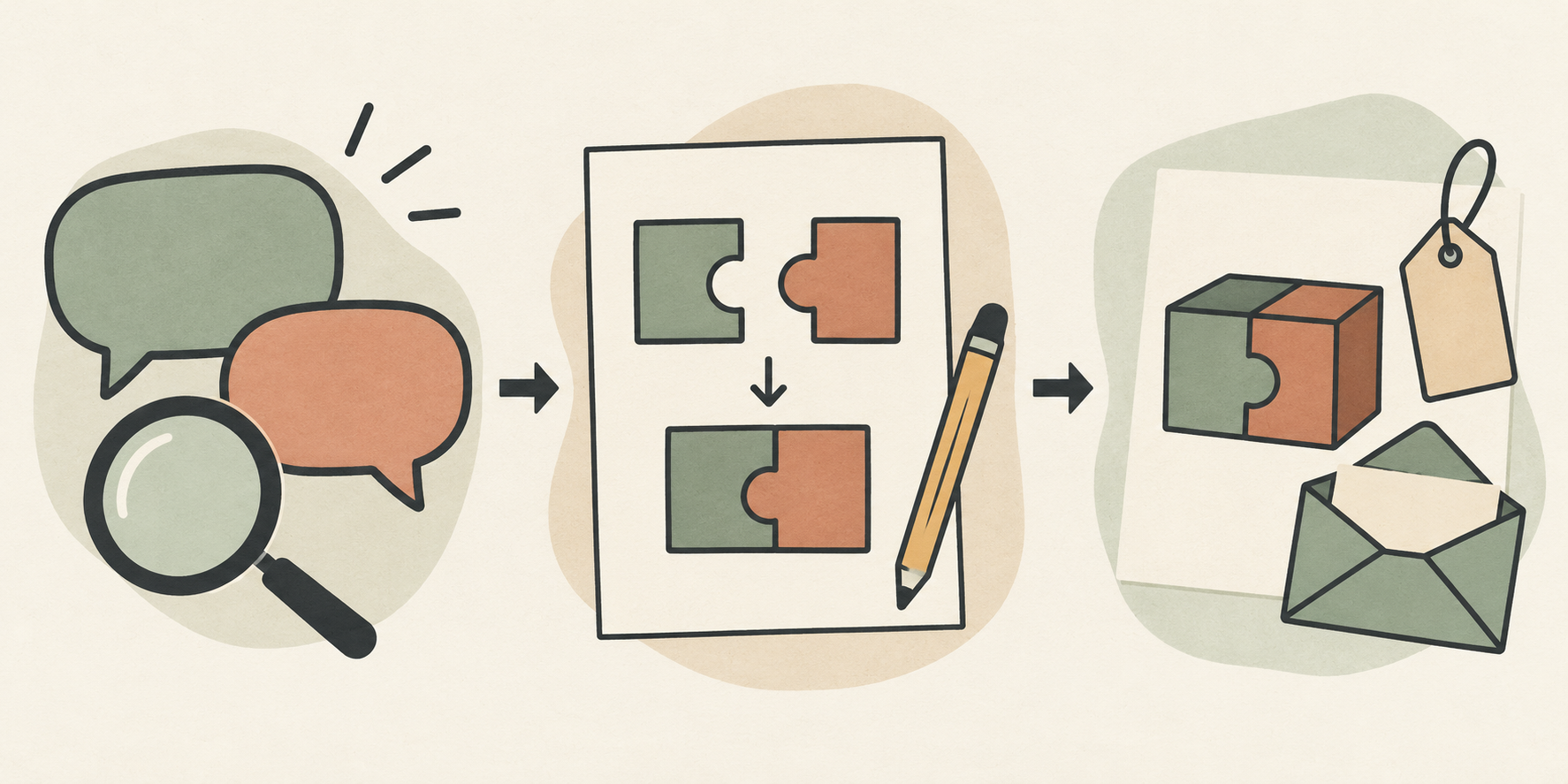
Choose the question
Identify what the audience needs to understand in a specific situation.
Teach a useful step
Show an explanation supported by checked details, with its conditions visible.
Clarify the offer
Connect the relevant work or service to a destination that answers the next question.
A fictional example: a ceramics studio answers a fit question
Imagine a ceramics studio that sells decorative planters. A customer asks whether a nursery pot they already own will fit inside a particular design. The studio wants to answer the question and make the relevant products easier to inspect. This is a fictional planning example, not a survey respondent’s story or a measured campaign.
The teaching task is to explain which dimensions to compare. The studio checks the usable internal dimensions of the planter and the outside dimensions of the example nursery pot. It also verifies any shape or clearance condition that affects fit. The creator can then show where those measurements are taken, using the actual items or a clearly labeled demonstration.
The draft opening could be: “Before choosing this planter, compare your pot’s outside dimensions with the usable space inside.” The explanation shows the relevant measurement points and directs the viewer to the dimensions for that specific product. The studio should replace any illustrative detail with verified product information before publishing.
The offer can follow naturally: “See the dimensions and available finishes for this design.” The linked page should contain those details. If a particular shape still makes the answer uncertain, the next step can invite the customer to ask about it. The content does not need to promise a fit that has not been checked.
This brief gives the creator several concrete responsibilities: show the comparison clearly, keep the product condition visible and identify the destination. It gives the studio a different responsibility: confirm that the measurements, product variant and page information agree.
A freelance product photographer could use the same planning approach for a different question: “What should I include in a shoot brief?” Their lesson might explain how to describe the intended use, required views and delivery needs. A clearly hypothetical sample brief could illustrate the answer, followed by a link to the photographer’s portfolio or inquiry page.
Once the audience question, checked facts and destination are clear, the studio or photographer can judge whether the piece delivers its promised explanation. Later questions from viewers can reveal details worth clarifying in a follow-up.
A short brief for your next educational post
Copy these prompts for one piece of content. Keep the audience’s question and your commercial purpose in separate fields, even when both will appear in the same post. This is a planning tool derived from the discussion, not a questionnaire used in the study.
Audience and situation: Who has this question, and what are they trying to do? Describe the task rather than assuming that a broad demographic category tells you what the person needs.
Question to answer: Write one question in the audience’s words. Note where it came from and remove personal information. If it is a topic you proposed yourself, label it as a hypothesis rather than a confirmed customer need.
Useful step: What will someone be able to understand, compare or do after seeing the content? Describe the explanation or demonstration. Note anything that would make the advice unsuitable for a different product, situation or level of experience.
Evidence and fact-checking: Which source, product detail or example supports the answer? Name who will verify it. Distinguish actual information from a fictional example, and identify any detail that must be checked before publication.
Work or offer: What relevant product, service or expertise are you presenting? Explain the connection to the question. If the connection feels forced, narrow the lesson or choose a more relevant destination rather than adding an unrelated sales claim.
Next step and destination: What can the reader do next, and what will they find there? Check that the link delivers the specification, example, portfolio or contact route promised in the content.
Review after publication: What did people ask next? Which explanation needs clarification? Use your existing reporting and keep observations about this post distinct from general claims about educational content marketing.
How we analyzed the survey
We analyzed the individual microdata from NIC.br/Cetic.br’s TIC Domicílios 2025, version 1.0. The released sample contains 24,535 respondents aged 10 or older. Our analysis is limited to adults aged 18 or older in the defined subgroup. The detailed collection report places fieldwork between March and September 2025 across Brazil. Each activity question refers to the three months before that person’s interview, not a shared calendar quarter. [1][3]
We first followed the survey’s Internet-use and own-content questions. The included adults said they had posted material they made themselves and reported either selling products or services or promoting their work through that content. A yes to one purpose qualifies even if the other answer is unknown. People whose answers establish neither purpose and leave membership uncertain are not included as confirmed promoters or sellers. [2]
Within this group, we counted affirmative answers to teaching or giving tips. Unknown or unanswered teaching responses remain in the denominator. The remainder therefore includes both negative and unknown answers; it should not be described simply as people who did not teach. The complete negative/unknown response breakdown and the range obtained by assigning unknown answers to either yes or no are withheld under the reporting rules fixed before analysis.
The weighted estimate uses the producer’s original survey weight. Sampling uncertainty uses all 200 supplied bootstrap replicate weights, recalculating both the numerator and denominator in every replicate. We followed the native design settings and the producer method’s normal-approximation margin, then rounded the result and interval to one decimal place. Of the 2,110 included respondents, 1,307 affirmed teaching or tips. Dividing those counts without weights gives a sample share of 61.9%. [4]
The calculation and publication rules were set before examining the paired answers. Two independently written implementations reproduced twelve prespecified published whole-population checks before calculating the conditional result. Those checks concern separate purpose totals and percentages; the producer’s published table is not itself the adult conditional estimate shown here. [5]
Our reporting rules require adequate sample counts and limit the influence of unusually large survey weights. They also withhold a complete secondary panel when its smaller categories do not meet the preset display rule. These are analyst reporting safeguards, not guarantees of representativeness or a formal privacy guarantee. We make no claim about the size or effect of withheld categories.
All estimates use the published native R survey object. A separate text-export comparison did not establish exact numerical equivalence, so that export was not used for analysis. This validation change was documented after inspecting source formats and before the published checks or target results; the scientific definitions and calculations were unchanged. The technical download gives the full chronology. [6]
This is an Influence IQ reanalysis of survey responses, not a test of a marketing intervention. It adds a conditional view to the producer’s separate purpose statistics. The downloads contain the permitted aggregate results, method and reproduction code, with no respondent records or identifiers. The microdata are available separately under CC BY 4.0; our interpretations do not imply the producer’s endorsement. [1][7]
- Download the English aggregate results (CSV)
- Download the method and reproduction code (ZIP, English)
No sign-up required. Downloads contain the permitted aggregate results and English technical method, with no respondent records, identifiers or withheld breakdowns. The Portuguese questionnaire and source microdata are available separately. [1][2]
Sources and notes
- NIC.br/Cetic.br, TIC Domicílios 2025, individual microdata, version 1.0. Influence IQ reanalysis of adults affirming own-content work promotion or selling. The source sample and the conditional analysis group are different denominators.
- Portuguese source questionnaire: C11_C asks about posting material the respondent made; TC11_C covers teaching or giving tips, TC11_G selling products or services, and TC11_H promoting one’s work. The purposes refer to the preceding three months and may concern different pieces of content.
- The detailed collection report states March–September 2025. We use that account of fieldwork; the dataset landing page has an inconsistent November date field. The available documents do not establish the cause of that discrepancy.
- The producer’s methodological report describes the individual survey’s 200 bootstrap replicates and margins using 1.96 times the standard error. Our ratio uses the supplied combined replicate weights and native variance settings. The interval describes sampling uncertainty, not all measurement or nonresponse error.
- Published TC15 tables report separate purposes for the full individual population aged 10 or older. We checked the teaching, work-promotion and selling totals, percentages and their margins, without treating those published margins as the adult conditional overlap.
- The published native RData remained the canonical scientific source. A versioned validation amendment removed the failed auxiliary text-export equality requirement before controls and target estimates. It did not change the eligible group, weights, estimators, control tolerances or reporting rules; no text-export equivalence is claimed.
- The individual microdata are licensed under Creative Commons Attribution 4.0. The reproduction package identifies NIC.br/Cetic.br as the source and describes our analysis and modifications. This attribution does not imply endorsement. No producer artwork or respondent records are redistributed.
The article, brief, figure labels and results CSV are available in ten languages. The technical reproduction package is in English and the source questionnaire is Portuguese. Every edition describes the same Brazilian survey group and analysis.