A different track can need a different license check
The artist stays the same, but the soundtrack changes. An analysis of the 2017 Free Music Archive research dataset shows why the replacement track needs its own source and license record.
An original analysis of license notices in the FMA research archive assembled on April 1, 2017.
Abstract
When replacing music in a business or creator video, keep a separate source and license record for the new track. In the 2017 FMA research archive, 18.2% of 8,450 artist entries with at least two tracks contained different named Creative Commons license families. Leaving six inconsistent source labels unclassified reduces that share to 9.6%, but also leaves far fewer tracks with an identified core license family. These are two ways of reading the source, not an estimated range.[1][2]
The study shows why the artist name alone can miss differences between tracks. It compares historical notices, so it does not establish current permissions or identify mistakes. Even tracks with matching license families can have different versions or country-specific terms. The free record sheet below helps a creator and business keep the selected track, its exact notice and the planned use together when an edit changes.
The video is nearly finished. A small business likes the edit but wants a lighter soundtrack. The creator finds another song by the same artist, swaps the audio and sends the new cut. The pictures, caption and campaign stay the same. It can feel like a small creative adjustment.
The information supporting the original music choice has changed, too. A source link saved for the first track does not describe the replacement. Even a familiar artist name does not tell the next reviewer which license notice belongs to the audio now in the video.
Checking each track is established advice. We wanted to make the reason more concrete: within a music archive, how often did tracks grouped under one artist entry actually carry different named license families?
Each track needs its own source record
The artist name did not always identify one license family
We examined the curated FMA research archive assembled in April 2017. Among its 106,574 track entries, 98,683 belonged to 8,450 artist entries with at least two tracks. Each artist entry counted once, whether it had two tracks or a much larger archived catalog. These are platform entries, which can represent groups or collaborations, rather than a count of individual musicians.[1]
In 1,534 of those 8,450 entries, at least two tracks had different named core license families. That is 18.2%. A family means a combination such as CC BY, CC BY-NC or CC BY-NC-SA. The comparison keeps version numbers and country-specific versions separate from this first question about the named conditions.[2]
That 18.2% depends materially on how we interpret six source labels. They say “3.0 International,” while their linked Creative Commons pages identify the corresponding 3.0 Unported licenses. Our main calculation follows those exact, reviewed links and preserves the label mismatch. A stricter calculation leaves those notices unresolved instead. It finds 813 differing artist entries out of the same 8,450, or 9.6%.[3]
The stricter reading also loses information: resolved core-family coverage drops from 96,945 of 98,683 tracks, or 98.2%, to 62,370, or 63.2%. Artist entries in the third category rise from 213 to 3,613. The smaller difference count therefore does not show that the remaining catalogs match. It reflects a decision to leave more source notices unclassified.
In the main calculation, 6,703 entries had one core family across every observed track. The remaining 213 could not be placed in either that category or the observed-difference category. They include public-domain tools, other notices and unresolved records. Those notices are outside this six-family comparison; they are not automatically invalid licenses or missing information.
Two treatments of the source labels, with the same 8,450 artist entries
2017 FMA archive; every artist entry has at least two curated tracks. Main core-family track coverage: 96,945/98,683 (98.2%). Strict coverage: 62,370/98,683 (63.2%).
| Result | Main count | Main share | Strict count | Strict share |
|---|---|---|---|---|
| At least two core license families observed | 1,534 | 18.2% | 813 | 9.6% |
| Every track resolves to one core family | 6,703 | 79.3% | 4,024 | 47.6% |
| Other or unresolved notices; neither category above | 213 | 2.5% | 3,613 | 42.8% |
Two tracks from one artist can start different conversations
One archived artist entry, The Cheese Mites, makes the family distinction easy to see. Its 22 curated track records included 17 with CC BY 4.0 notices and five with CC BY-NC 4.0 notices. The version number matched; the NonCommercial condition did not. This example does not depend on the six source-label mismatches.[2]
For a business choosing music, that difference changes the question to investigate before using a track. It does not establish that the artist did anything wrong. Different works may carry different notices, and the archive does not show the reasons for those choices or any separate permissions that might exist.
A second example shows why the overall percentage is not a probability for a random replacement. The Phemale entry contained 155 tracks: 154 with CC BY-NC-SA 3.0 US notices and one with CC BY-NC-ND 4.0. It counts as one differing artist entry, just as an entry with two differently labeled tracks does. We did not observe creators choosing songs or measure how frequently their replacements crossed those differences.
The useful conclusion is specific: the artist entry can help you find music, but it cannot substitute for the notice attached to the track you select. Neither historical example is a recommendation to use a particular song today.
Keep the letters, version and source together
A Creative Commons music license is not a single standard permission. The six core families combine Attribution (BY) with different conditions. NonCommercial (NC) limits commercial uses; ShareAlike (SA) places conditions on sharing adaptations; NoDerivatives (ND) limits sharing adapted material. The exact license text matters beyond these short labels.[4]
For video, ND deserves particular attention. CC BY-NC-ND 4.0 defines synchronizing music in timed relation with a moving image as creating adapted material, and it does not grant permission to share that adaptation. An unchanged audio file can therefore raise an adaptation question when it is paired with video. Crediting the artist does not by itself resolve that question.[5]
For NC, distinguish the intended use from the account type. Creative Commons says the assessment depends on the use and its purpose, rather than simply whether the user is a business or nonprofit. Write down the planned placement, including an ad or sponsored video, so that the person reviewing the notice knows what the music will accompany.[6]
Even within the 6,703 artist entries with one family throughout, 646 had different versions, country-specific versions, or both. A country-specific version is often called a port. The other 6,057 shared one canonical notice. Matching family letters therefore did not always mean matching license text, and matching text does not verify who holds every relevant right. Keep the complete notice link with the track, rather than shortening the record to “CC music.”
An album was a narrower shortcut, but still a shortcut
Across 12,122 album entries with at least two tracks, 225 had different core families: 1.9%. Some albums contain multiple artists. Restricting the comparison to 11,020 album entries whose tracks all shared one artist ID left 123 with differences, or 1.1%. These are separate denominators, and neither comparison turns an album title into permission for its tracks.[2]
Catalog size also changes the opportunity to find a difference. Among artist entries with exactly two tracks, 223 of 1,500 differed, or 14.9%. Among entries with at least 26 tracks, 323 of 695 differed, or 46.5%. The intermediate bands are not a steadily rising sequence. These counts describe how much of each catalog the archive contains, not a causal effect of releasing more music.
For a team preparing several versions of an ad, the implication is to keep a short list of the actual tracks under consideration. The study does not establish that an artist with fewer archived tracks is a safer choice, or that an album without an observed difference has no other tracks with different notices.
Differences also occurred within album entries
Main coding, 2017 FMA archive. Every eligible entry contains at least two curated tracks. Artist and album frames overlap.
| Comparison | Entries with different families | Eligible entries | Share with differences |
|---|---|---|---|
| Artist entries | 1,534 | 8,450 | 18.2% |
| All album entries | 225 | 12,122 | 1.9% |
| Album entries with one artist ID | 123 | 11,020 | 1.1% |
More archived tracks create more opportunities to find a difference
Main coding within the same 8,450 eligible artist entries. Bands refer to archived track counts, not complete discographies.
| Tracks in the artist entry | Eligible entries | Entries with different families | Share with differences |
|---|---|---|---|
| 2 | 1,500 | 223 | 14.9% |
| 3–5 | 2,082 | 254 | 12.2% |
| 6–10 | 2,419 | 314 | 13.0% |
| 11–25 | 1,754 | 420 | 23.9% |
| 26+ | 695 | 323 | 46.5% |
Make the replacement visible in the handoff
The simplest workflow change is to attach the source record to the selected track, alongside the video brief. Keep the original record when the soundtrack changes and start another for the replacement. That makes it clear which evidence belongs to which edit.
The creator can supply the exact track title, asset identifier, source page and file reference. The business can describe where the finished content will appear and who will resolve any permission questions. A short unpaid post, a sponsored creator video and a paid placement should not be collapsed into the vague field “social media.” The record should describe the actual plan.
Save the displayed notice and its full link, including the version and any port. Note the date you captured them. If the title and link disagree, preserve both and resolve the discrepancy; do not silently choose whichever label seems more convenient. A dated copy also helps another reviewer understand what you saw if the page later changes.
Before handing off the final export, check that its audio matches the track in the record and that the intended use still matches the brief. Keep required credit wording and the location where it will appear with that record. These are recommended review steps, not measured time savings or evidence that the study's tracks are cleared for a campaign.
Where the available notice does not support the intended use, ask the relevant rights holder for permission or choose another track whose terms fit. A CC notice may not supply every right needed for a use, including rights in third-party material.[6] Keeping that unresolved point beside the exact track gives the next person a concrete issue to resolve.
Keep the new track and its evidence connected
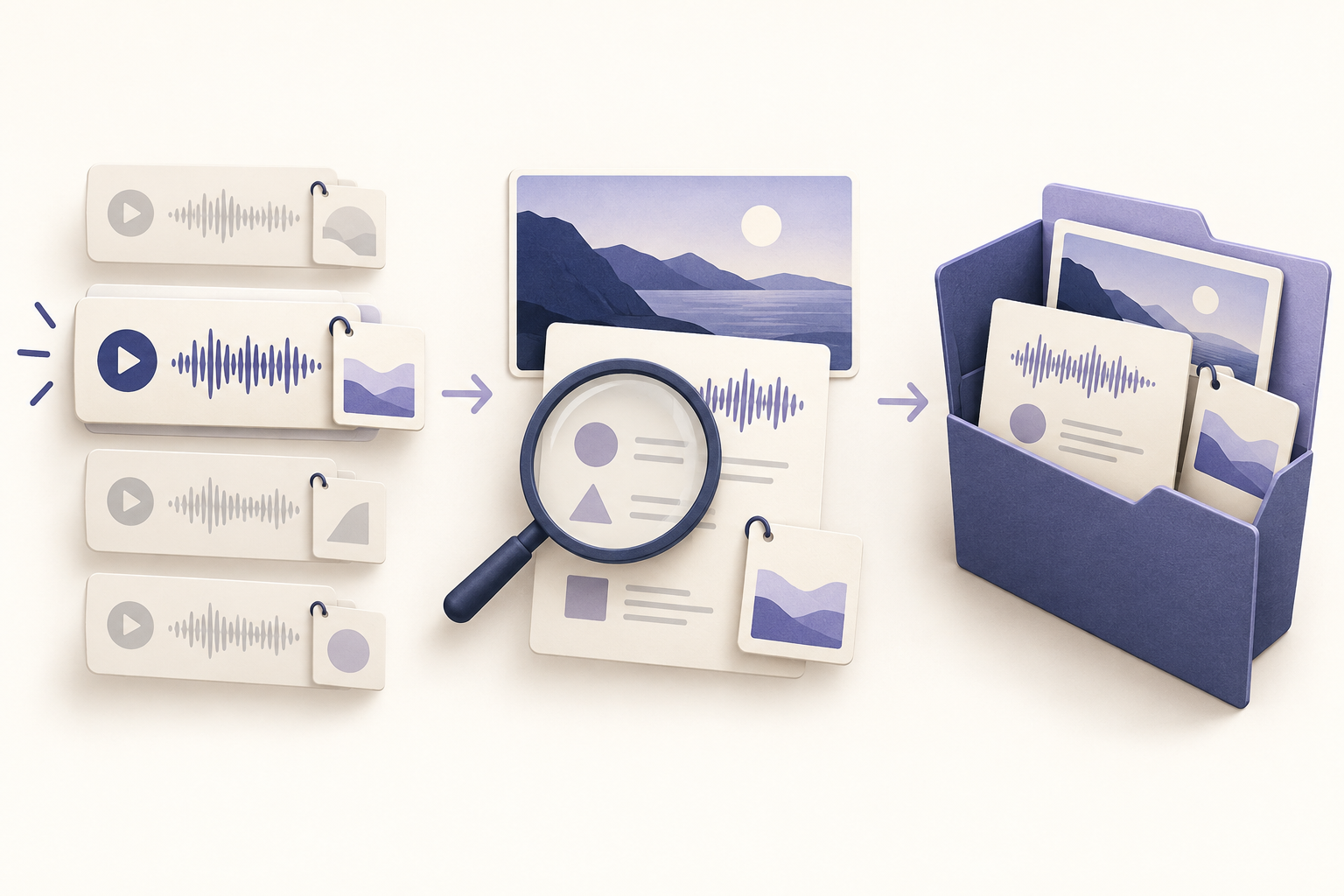
Identify the track
Save its exact asset, source and audio file reference.
Review its notice and planned use
Keep the full license link, any extra permission and open questions together.
Connect it to the final edit
Confirm that the export uses the track named in the record.
A track record you can copy into the brief
Use one record for each selected track. The downloadable package includes a blank sheet and a fictional worked example, with no registration required. This is a way to organize evidence and decisions, not a permission certificate.
Track identity: title ______; credited artist ______; exact asset ID ______; source page ______; audio file or version used ______; date checked ______.
Notice: displayed license wording ______; complete license URL ______; version and country-specific version, if present ______; saved copy or screenshot reference ______; discrepancies to resolve ______.
Intended use: business or creator ______; video or content reference ______; placement and account ______; paid, sponsored or other context ______; how the music will be used with the content ______.
Review: required credit and its placement ______; additional permission or supporting correspondence ______; open question and person responsible ______; decision and its basis ______; reviewer and date ______.
Replacement: previous track and record ______; new track and record ______; changes to the planned use ______; final export reference ______; person confirming the export uses the reviewed track ______.
Leave an unanswered question visible. A blank permission field is a prompt to investigate, not evidence of permission. If the creator and business work in different documents, use the same track identifier in both so the records can be connected.
- Download the notice-comparison and coverage tables (CSV)
- Download the analysis, blank record sheet and fictional example (ZIP)
No sign-up required. The ZIP includes aggregate results, calculation code and a blank sheet with its fictional example. Technical reproduction instructions are in English. Original metadata remain at the source; no music files are included.
A fictional soundtrack change, with the missing decision exposed
Imagine a fictional bakery, Cedar Oven, commissioning a 20-second product video from a creator named Maya. The team intends to use the final video in a paid social ad. Every name, track and asset reference in this example is invented; none is a track offered for use.
Original record: “Morning Window,” credited to the fictional Paper Lanterns; asset DEMO-A; source https://example.org/music/demo-a; file demo-a.wav. The example source displays CC BY 4.0. The record contains https://creativecommons.org/licenses/by/4.0/ and a saved source copy. This entry describes the notice; it is not a conclusion that the bakery has every permission it needs.
The bakery then prefers “Warm Counter” by the same fictional artist. Maya opens record DEMO-B, links it to DEMO-A and saves https://example.org/music/demo-b. The example replacement displays CC BY-NC 4.0. The planned paid placement remains in the intended-use field, so the NC question is visible before the final audio is substituted.
The replacement record names demo-b.wav as the audio file, gives October 1, 2026 as its fictional check date and preserves https://creativecommons.org/licenses/by-nc/4.0/ as the notice link. The credit field says “wording and placement to confirm.” Additional permission is “none documented.” Maya is responsible for supplying the source; the campaign owner is responsible for the outstanding use decision. The draft export remains identified as awaiting that decision, so nobody has to infer its status from a folder name.
The decision field reads: “Replacement not selected for the ad. Campaign owner to resolve whether separate permission covers this planned use, or choose another track and complete its record.” The review stays open because no additional permission is documented. Evidence for the first song does not establish terms for the second.
The handoff now names the change, the source and the outstanding decision. Once the team has a supported music choice, it can connect that track’s record to the final export. If another editor takes over, they can see which track is being considered and why the music choice is still open.
How we compared the archived notices
The source is FMA: A Dataset for Music Analysis, by Michaël Defferrard, Kirell Benzi, Pierre Vandergheynst and Xavier Bresson. We used its fixed 2017 metadata archive, joining all 106,574 curated track IDs to their original notice records. The 3,153 raw-only records stayed outside the curated frame. The source curators excluded tracks they could not download or process, and tracks whose licenses prohibited redistribution.[7] This selection already shapes which notices the archive contains. We did not download or inspect audio.[1]
We fixed the group rules and exact notice mapping before calculating group outcomes. Positive source artist or album IDs defined entries; names did not merge them. A group needed at least two curated tracks. The mapping used 114 exact title-and-URL pairs, preserving versions, ports and the six flagged source-label aliases. Missing album IDs did not remove otherwise valid artist records.
An entry counted as different when it contained at least two resolved core families, even if other tracks had noncore or unresolved notices. It counted as family-matching only when every track resolved to one core family. All remaining entries stayed in the third category and the denominator. The stricter calculation changed only the six flagged mappings, leaving tracks and groups unchanged.[2]
These are descriptive counts from a selected historical archive. Track entries are not verified unique audio works, and the archive is not a complete artist discography or a current census of music available online. The age of the snapshot does not itself make a CC license expire; it limits what this dataset establishes about present source pages and permissions.[6] The downloadable code, aggregate tables and source manifest allow the comparison to be reproduced.
Sources and notes
- Defferrard, Michaël; Benzi, Kirell; Vandergheynst, Pierre; and Bresson, Xavier. FMA: A Dataset for Music Analysis, ISMIR 2017. Metadata archive assembled April 1, 2017, with 106,574 curated tracks. Source metadata are licensed CC BY 4.0; individual audio licenses are separate. Influence IQ joined, classified and aggregated the metadata. No audio is redistributed.
- Influence IQ analysis package: fixed protocol, exact notice map, source checksums, calculation code, aggregate tables and record-sheet examples. Main artist difference: 1,534/8,450; stricter source-label coding: 813/8,450. The different source interpretations are not confidence bounds. Example source artist IDs 21659 (The Cheese Mites) and 9454 (Phemale).
- Six exact source labels call no-port 3.0 licenses International; the corresponding official URI pages identify Unported. For example, the recorded BY-NC link resolves to Attribution-NonCommercial 3.0 Unported. The main mapping follows these reviewed identities; the strict sensitivity leaves all six exact pairs unresolved.
- Creative Commons overview of the six licenses and their named conditions. Short family labels are an introduction; consult the exact version's terms for the intended use. This article does not determine whether a specific campaign has all required rights.
- CC BY-NC-ND 4.0 legal code, sections 1(a) and 2(a)(1): timed synchronization of music with moving images is adapted material; the license does not grant sharing of adapted material. Applicable exceptions or separate permissions may change a particular case.
- Creative Commons FAQ: NonCommercial depends on the use, additional rights may be relevant, and a license's age does not itself establish expiration. Consult the specific notice and relevant rights holder when the intended use is unresolved. Official guidance checked October 22, 2026.
- Defferrard et al., FMA: A Dataset for Music Analysis, section 2.2. The source authors report exclusions for download or processing failures and for licenses that prohibited redistribution. The resulting curated archive is the study frame; it is not a random sample of music licenses.
Every language edition describes the same 2017 FMA research archive. A translation does not create a study of a different country or determine local permissions.