Changed a short link? Check where returning readers land
A server change and a returning browser can disagree about where a campaign link goes. We followed the same 12 links before and after an update.
48 browser navigations across 12 controlled link cases
Abstract
Changing a campaign link can leave returning readers on its original page even when a new request reaches the updated destination. In a loopback experiment using ChatGPT Browser, 6 of 12 previously visited links still opened the original page about 14 seconds after the first visit. All 6 reused a redirect without contacting the server. At about 83 seconds, all 4 cases originally set to expire after 75 seconds reached the updated page. Two permanent redirects issued without a cache directive still opened the original page. Check the published link from both a returning browser and a fresh client when the change matters. [1][2]
A partner has already shared the short link to your event registration page. The venue changes, so you edit the link to send people to a new registration page. On your first check, the new page opens. The people who opened the earlier link have a different starting point. Their browser may still have a usable copy of the redirect that sent them to the original page.
A redirect tells a client to request a different address. A browser can store that response under the short link it just requested, even if the page it opens afterward has its own cache rules. Updating the destination at the server changes the response to the next request that arrives there. A visiting browser may be able to use its stored response and skip that request. [1]
The original cache policy and the current response
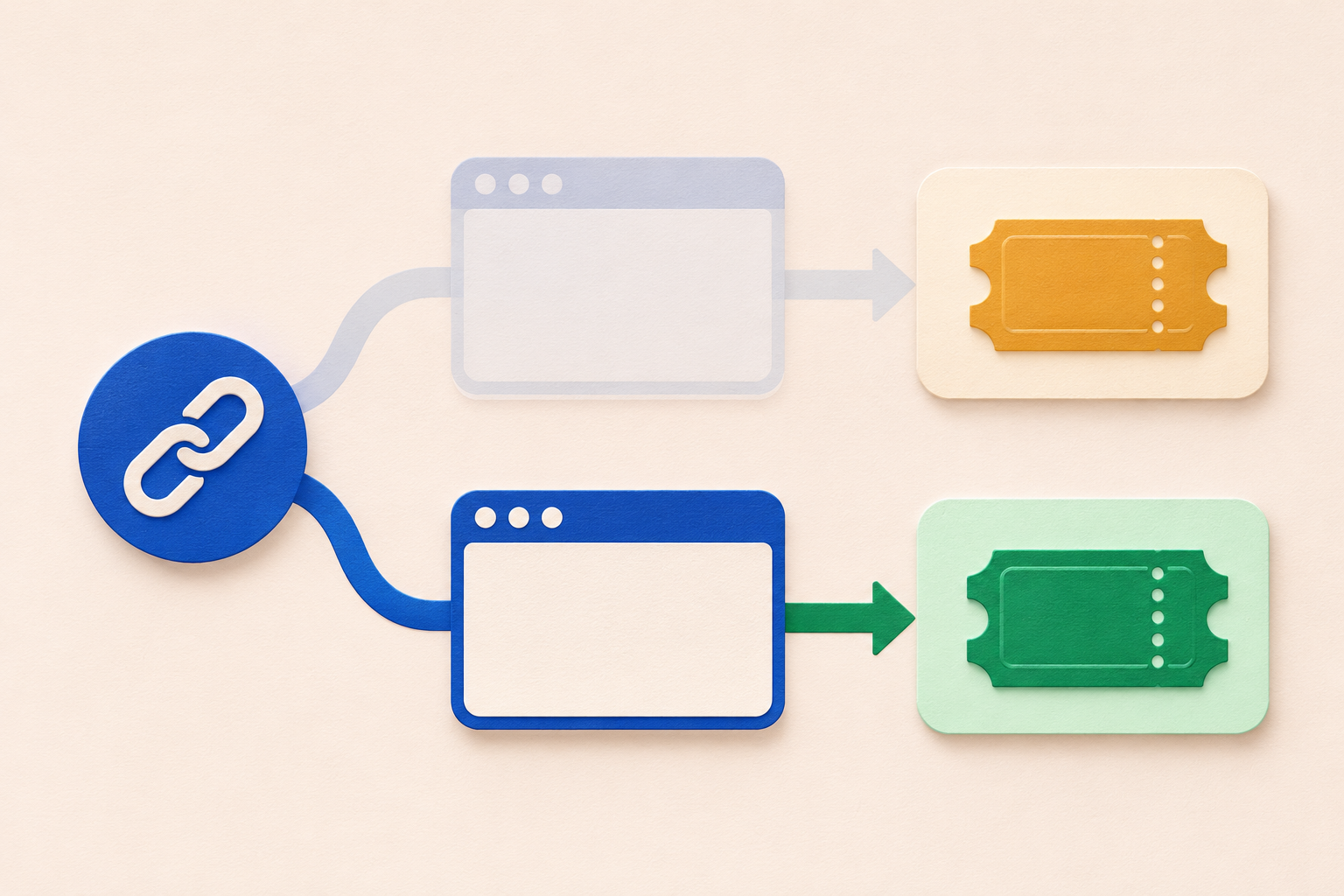
Returning readers can see the old destination
We tested 4 redirect codes, 301, 302, 307 and 308, under 3 initial cache policies. After one visit to every link, we pointed all 12 links to updated pages and added no-store to every response. On the first revisit, around 14 seconds after each original click, all 4 links that started with no-store reached the updated page. All 4 that started with max-age=75 reused their original redirect. With no initial cache directive, 302 and 307 reached the new page, while 301 and 308 reused the original redirect. [1][2]
We also made 12 curl requests to the very same short URLs during the updated phase. Each command showed the new destination and each request appeared in the origin log. That confirmed the server was already sending the updated address. During the browser revisits that landed on the old page, the origin log contained no request for that short URL. The result separated an origin update from what a returning browser actually did.
Cases that reached the destination the server currently offered
Each original cache policy covers 4 redirect codes. The columns compare three visits after the original click.
| Original cache policy | Update at about 14 seconds | Update at about 83 seconds | Rollback at about 101 seconds |
|---|---|---|---|
| No explicit directive | 2 | 2 | 2 |
| no-store | 4 | 4 | 4 |
| max-age=75 | 0 | 4 | 4 |
What happened on the next visits
At the next check, around 83 seconds after the original clicks, all 4 timed cases reached the updated page. The 301 and 308 links that originally omitted a cache directive still opened the original. We observed those two cases again during rollback, around 101 seconds after the original visits. The experiment did not measure when the browser would eventually send a new request for those two links.
For rollback the server issued a third, distinct destination so we could see which visitors actually reached the rollback response. The 10 cases that had reached the update all reached the rollback page. Each of those updated responses had used no-store. The 2 remaining cases still opened the original page, without a new origin request. In a real rollback the older URL might be the intended destination. A page that happens to look correct cannot tell you which redirect was used.
Check the link after you change it
Save the exact short URL you distributed, including any query string. Before changing it, open that URL in the browser you will use for the returning visit. Change the target, then follow the same link again from the same browser, as a reader would. Verify the destination address and the action the page should offer. Test the same short URL with a separate client that has no stored response. A different query string is a different URL and can get a fresh response even when the published URL still reuses its earlier redirect. [1]
If people could land on an older page after the change, consider keeping that page useful during the transition. For the event example, update the old page with the correct venue and a way to reach registration if you control it. If you own the redirect, decide how long a destination is safe to reuse and use a cache policy that fits. Sending no-store with the revised response can prevent storing that response when it is received. Readers whose browser is still using the older redirect may see the earlier destination until they make a new request. [1]
Verify a short-link change before you announce it

Save the published link
Record the short address exactly as people received it, including any query string.
Check the returning visit
Follow the link in the browser that already visited it and inspect the page you reach.
Check the fresh visit
Open the identical short link in a client with no stored response and compare the final destinations.
The ZIP includes the local experiment, navigation and origin receipts, and English replay instructions.
Methods
We ran one 12-case follow-up on November 19, 2026. The in-app browser sent a user-agent string identifying Chrome 157.0.0.0. The fixture ran on loopback HTTP and recorded the exact request path, time, status, destination and cache header. The browser followed HTML links in 4 menus. The link paths stayed identical across the original, early revisit, later revisit and rollback stages. Menu pages and landing pages used no-store throughout.
Each row in the table groups 4 status codes under the same original cache policy. Its counts come from the final address for each navigation. A second calculation matched those navigations to origin responses by case and time. A request using curl 8.7.1 with no stored response was a direct control for each identical address. The experiment used no campaign account, CDN, public shortener or redirect from a live campaign.
Sources and notes
- RFC 9111 on HTTP caching, including how caches decide whether to store or reuse a response and how no-store applies.
- RFC 9110 on HTTP semantics, including 301, 302, 307 and 308 redirects.
All editions use the same 12 controlled link cases.