Build vs buy AI: a study of Brazilian businesses
Ready-made AI and development work often coexist within a company. A new analysis of Brazil’s TIC Empresas 2025 survey separates work done by employees from work commissioned from suppliers, then turns the distinction into an ownership worksheet.
Brazilian formal enterprises with 10+ people working in selected industries; AI-question eligibility requires an IT area or specialist. TIC Empresas 2025, collected February 2025–January 2026. Analysis completed October 17, 2026.
Abstract
Among eligible Brazilian enterprises using AI for marketing or sales, 69.0% of those with complete sourcing answers reported both ready-made AI acquisition and some development or modification. Among the ready-made users in that group, the proportion was 81.1%. The respective pointwise 95% confidence intervals are 61.9%–76.1% and 74.7%–87.5%.[1][4]
These weighted estimates use TIC Empresas 2025, covering selected formal enterprises with 10 or more people working; the AI questions require an IT area or IT specialist. The analysis uses 447 complete-answer respondents, including 376 ready-made users, from fieldwork in February 2025–January 2026. Sourcing describes the company’s AI portfolio, not necessarily its marketing application or the same system. The practical implication is to name who develops, modifies and maintains each system, including commissioned suppliers.
A marketing manager asks a seemingly straightforward question: should we build an AI tool or buy one? The discussion starts with a product shortlist and a possible development brief. Soon someone asks who will adapt the system, who will check its outputs and who will fix it when the business changes.
Those questions can involve different people and different systems. Acquiring a ready-made product does not describe everything the company does with AI. Equally, having employees who review AI-generated content does not mean they build the software.
We examined the sourcing answers of the same businesses in Brazil’s public enterprise survey. The result offers a specific benchmark for the build-versus-buy discussion. The survey’s term is “acquired ready to use,” which does not necessarily mean a paid purchase or subscription.
One company can use several AI sourcing routes

- Acquire ready-made software
- Develop or modify with employees
- Commission development or modification
Build, buy and commission describe different kinds of work
The survey distinguishes five routes: AI software or systems developed by employees; modified by employees; open-source systems modified by employees; acquired ready to use; and developed or modified by external suppliers hired for that work. A company can report several routes.[2]
We group the first three as internal development or modification. Commissioned work stays separate: someone outside the company does that work. Simply acquiring a supplier’s existing product does not establish that the company commissioned development. Likewise, changing software is not necessarily training an AI model.
The technology definition is also broader than generative AI. It includes language and image analysis, speech recognition, prediction, workflow automation and autonomous physical machines. The results should not be read as statistics about chatbots, AI writing tools or AI agents alone.[2]
There is an important link the questionnaire does not make. It asks about the enterprise’s AI sourcing and, separately, whether it uses AI for marketing or sales. A firm could acquire a ready-made marketing product and commission an unrelated operational system. It could also report several routes for related systems. We can identify the combination within the company, but cannot assign a route to its marketing application.
Ready-made acquisition often accompanies development or modification
Among 447 eligible marketing or sales AI users with complete sourcing answers, an estimated 69.0% reported ready-made acquisition together with at least one development or modification route. Its pointwise 95% confidence interval is 61.9%–76.1%. Another 16.1% reported ready-made acquisition and none of those additional routes, with an interval of 10.5%–21.6%.[1][4]
These are weighted percentages. The first result comes from 307 respondents, but dividing 307 by 447 would give the unweighted sample fraction, not the population estimate. Survey weights account for how the respondents represent businesses in the defined population.
Now narrow the question to the 376 complete-answer firms that reported ready-made acquisition. Within that group, the same 307 respondents yield an estimated 81.1% also reporting development or modification, with a 95% interval of 74.7%–87.5%. The denominator has changed. The 69.0% and 81.1% figures describe the same combination from two perspectives, rather than two independent findings.
For a marketing manager, the implication is a question to ask internally: what work sits alongside the acquired tools? The answer might involve employees, commissioned suppliers or both. The survey does not show that the ready-made product itself was changed. A useful inventory therefore starts with individual systems and the work attached to each.
Selected AI sourcing combinations among marketing or sales users
Both rows use the 447 respondents with complete sourcing answers. Percentages are weighted.
| Reported sourcing combination | Estimate | 95% interval: lower | 95% interval: upper |
|---|---|---|---|
| Ready-made acquisition plus development or modification | 69.0% | 61.9% | 76.1% |
| Ready-made acquisition with no development or modification route | 16.1% | 10.5% | 21.6% |
Identify employee and supplier responsibilities separately
Within the complete-answer ready-made group, 66.3% reported commissioned development or modification and 39.0% reported internal development or modification. Those categories overlap: 24.2% reported both. Adding the two percentages would count some firms twice.[4]
The four combinations make the roles easier to see. Commissioned work without internal work accounts for 42.1%; internal work without commissioned work for 14.8%; both for 24.2%; and neither for 18.9%. Every group in this figure also reported ready-made acquisition. “Neither” means neither of the additional development routes, not that the business has no AI or no staff responsible for it.
The commissioned-minus-internal difference is 27.3 percentage points, with a pointwise 95% interval of 14.0–40.5 points. We calculated the difference within each survey replicate, preserving the relationship between the two answers. It describes how often the roles were reported, not their share of spending, staff time or business value.
This distinction matters when a marketing manager asks who can change something. An employee may adjust a system directly, while a supplier may need a specification, an agreed scope and a handover. A firm using both routes needs to know which arrangement applies to the requested change. The survey does not establish how well any of those arrangements worked.
Who reports the development or modification work?
All four groups reported ready-made acquisition. The denominator is the 376 ready-made users with complete sourcing answers, within the marketing or sales AI group.
| Reported sourcing combination | Estimate | 95% interval: lower | 95% interval: upper |
|---|---|---|---|
| Commissioned work, no internal work | 42.1% | 33.0% | 51.2% |
| Internal work, no commissioned work | 14.8% | 8.0% | 21.7% |
| Both internal and commissioned work | 24.2% | 15.9% | 32.5% |
| Neither internal nor commissioned work | 18.9% | 12.5% | 25.3% |
A specific benchmark for an established sourcing question
Combining internal and external AI sourcing is not a new idea. Hoffreumon, Forman and van Zeebroeck’s 2024 research examines ready-made acquisition and internal development or customization among 3,143 European firms. Its published abstract reports common complementarities between sourcing routes.[6]
Cetic’s own 2025 book reports separate AI sourcing percentages and discusses different adoption paths operating alongside one another. Our contribution is narrower: a reproducible estimate of which routes the same Brazilian firms report within the defined marketing or sales AI group, including the distinction between employee work and commissioned work.[5]
That benchmark helps frame a review, but it cannot choose a supplier or settle an investment case. A common arrangement can still be unsuitable for a particular business. The relevant decision is whether the proposed arrangement can perform the intended task and whether someone can maintain it after delivery.
A fictional supplier maps the work around its AI tools
Imagine a fictional Brazilian office-furniture supplier. Its marketing team acquires an existing tool to draft product descriptions. Employees also modify an internal AI system used to sort incoming inquiries, while an outside developer is commissioned to adapt a separate sales-forecasting system. These are illustrative arrangements, not a surveyed company or a recommended combination.
The marketing manager begins with one request: keep product descriptions consistent when specifications change. The acquired writing tool is only part of that task. Someone must supply the approved specifications, review the draft and decide when it is ready to use. Those responsibilities do not, by themselves, mean the business has developed or modified AI software.
The inquiry system poses a different question. A staff member changed how it assigns inquiries, so the team identifies who understands that modification, how a wrong assignment is noticed and who can reverse an unsuitable change. For the commissioned forecasting system, it instead checks what the external developer will hand over, which changes are included and who responds after delivery.
The team puts the three systems on separate worksheet rows. A single “we buy AI” label would conceal the employee modification and commissioned work; a single “we build AI” label would conceal the acquired product. The inventory does not require the same sourcing decision for all three.
The resulting actions are specific: name the description reviewer, document the inquiry-system change and agree the forecasting handover. The example makes no savings or performance claim. Whether those actions improve the business would need evidence from its actual work.
Use an AI ownership worksheet before choosing the next route
Use one row for each existing system or proposed application. Start with a concrete task, such as preparing product copy or sorting sales inquiries. Avoid a row called only “marketing AI”: it hides which work a tool is supposed to perform. This worksheet is a practical suggestion, not an intervention tested by the survey.
Record the system and task. Write its name, the business question it serves, the information it uses and the output someone acts on. Identify a person who can demonstrate the current process. If the proposed tool does not yet exist, separate the intended task from assumptions about what it will deliver.
Record how it is obtained and changed. Mark ready-made acquisition, employee development or modification, commissioned development or modification, or a combination. Describe the specific work behind each mark. Keep routine use, content review and configuration distinct from a claim that staff developed the software; ask the technical owner when the distinction is unclear.
Name the handover and maintenance owners. Identify who accepts a delivered change, who keeps the inputs current, who handles a fault and who can authorize a replacement. Where a supplier is involved, write down which responsibilities it actually accepts. A contact name alone does not explain what happens when the person is unavailable.
Define a review and an exit. Choose a concrete example the system should handle and a known situation that needs human review. Record how the team will inspect the result and what it will do if the system is unavailable or unsuitable. Use approved test information rather than assuming a new supplier may receive existing customer data.
A completed row should read like an instruction someone could follow: “Product-description tool; approved specification sheet; draft reviewed by the catalog editor; product changes supplied by merchandising; faults reported to the named tool owner; previous approved copy used while a fault is resolved.” This example describes responsibility. It does not classify ordinary editing as AI development.
Map the task, the handover and the next review
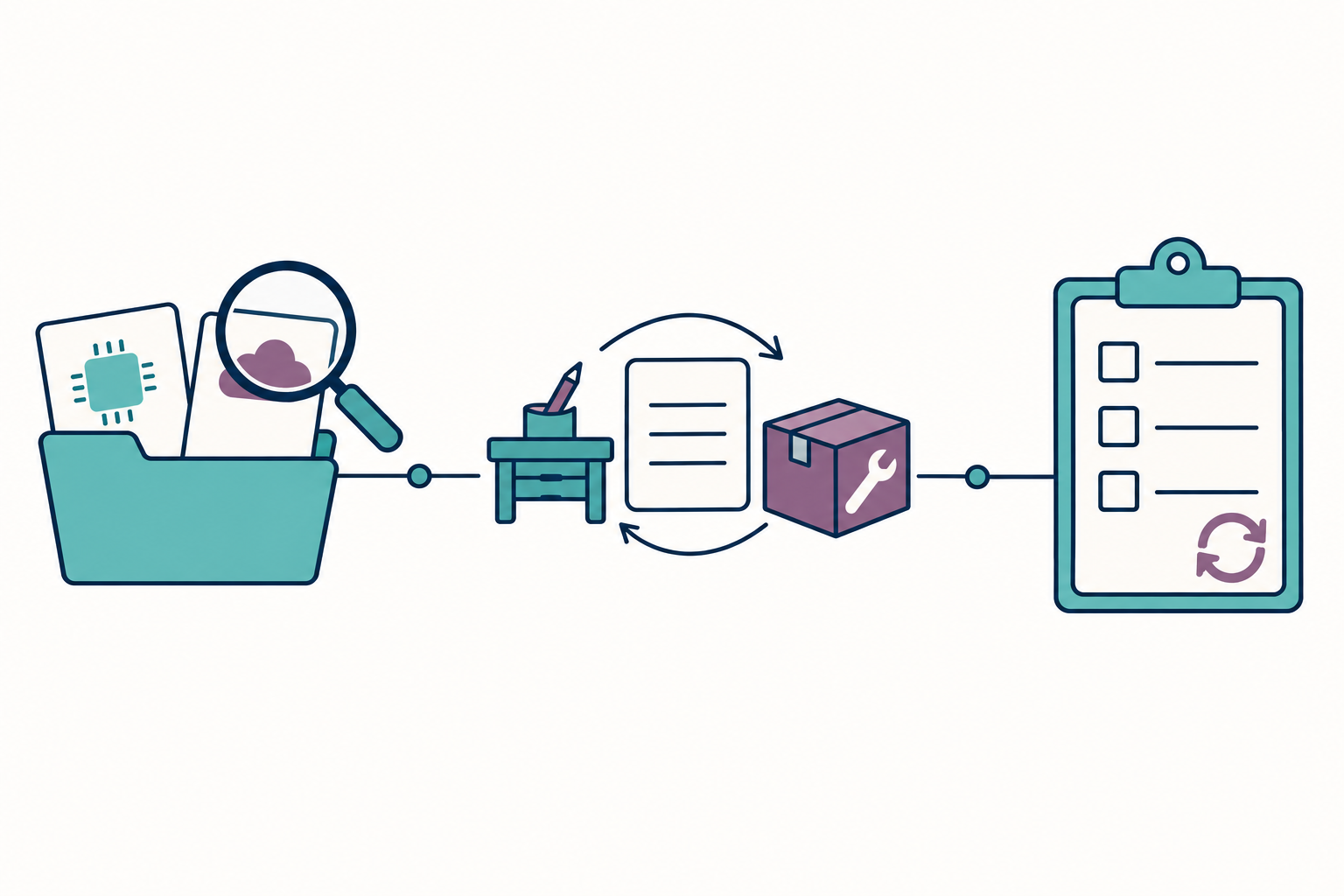
Identify the system
Name the task, inputs and expected output.
Assign the work
Separate employee responsibilities from supplier commitments.
Plan the next review
Agree who checks changes and handles problems.
Compare complete arrangements, including the work after delivery
For a new application, compare options against the same task and review criteria. Ask what an existing product handles as supplied, what would require employee work and what a commissioned supplier would deliver. Keep those answers separate before comparing any proposed combination.
If you prepare a budget, distinguish the product charge from development, review, maintenance and handover work. Use the business’s own quotes and time estimates. The Brazilian survey measures none of those costs, so its percentages cannot justify a claim that buying, building or commissioning will be cheaper.
When the business already has several systems, complete the inventory before adding another label to its strategy. The central result is that ready-made acquisition commonly appears alongside other sourcing routes in this particular group. The useful next step is to find the corresponding responsibilities in your own business, then make the next decision with those responsibilities visible.
How we calculated the AI sourcing combinations
We analyzed NIC.br/Cetic.br’s public confidentiality-treated TIC Empresas 2025 file, retrieved October 17, 2026. It covers active formal Brazilian enterprises with 10 or more people working in selected manufacturing, construction, trade and service industries. “People working” is broader than salaried employees. Firms below the threshold, public enterprises and sectors outside the survey frame are excluded.[1][3]
Interviews ran from February 2025 to January 2026, with the AI module in all three waves. Eligibility requires an IT area or IT specialist and use of at least one listed AI technology. H10_A identifies current marketing or sales use; H9A_A–E identifies sourcing. These AI questions have no specified 12-month recall period.[2][3][8]
The public file contains 4,171 records, including 1,085 reported AI users and 472 reporting marketing or sales use. Of the latter, 447 give yes/no answers to all five sourcing items; they represent 96.7% of the weighted group. The primary figures use those complete answers. The ready-made subgroup contains 376 respondents. Unknown answers are not recoded as no.[4]
For each percentage, we divide the event’s sum of weights by the domain’s sum of weights. We recalculate whole ratios and differences with the supplied 200 combined replicate weights and native variance settings. Pointwise 95% normal intervals use 1.96 standard errors, following Cetic’s method. They do not provide simultaneous guarantees for every comparison.[3][7]
We also restore the 25 incomplete respondents and consider every yes/no completion compatible with their known answers. The combined pattern then ranges from 67.7% to 69.0% of all eligible marketing or sales AI users. The conditional proportion among ready-made users ranges from 80.9% to 81.6%, allowing numerator and denominator to change consistently. These are missing-response bounds, not confidence intervals; sampling intervals remain wider.
The collection report gives an 8% overall response rate and 4,174 completed interviews. The reason for the three-record difference from the public file is not established. Weighting and sampling intervals do not remove all nonresponse or reporting bias, and do not quantify error from confidentiality treatment. We checked six AI marginals and their uncertainty against the publisher’s tables, but that does not prove every new joint relationship is unaffected by that treatment.[7][8]
We show selected sourcing patterns and the four complete-answer source-role combinations. A small no-listed-route remainder stays in the primary denominator without being interpreted. The downloads provide exact definitions, aggregate estimates, source hashes and code. Respondent data must be obtained separately from Cetic; no respondent records or identifiers are included here.[4][9]
- Download the sourcing combinations and confidence intervals (CSV)
- Download the analysis code and source instructions (ZIP; English instructions)
The CSV contains six aggregate figure rows and pointwise 95% confidence intervals. The ZIP adds conditional benchmarks, missing-response bounds, code, definitions and exact source hashes. It contains no respondent records or identifiers. Numeric fields use a decimal point.
Sources and notes
- NIC.br/Cetic.br, TIC Empresas 2025, public microdata with statistical confidentiality treatment, version 1.0, published June 15, 2026; retrieved October 17, 2026. Influence IQ calculated the joint estimates from the public respondent file.
- TIC Empresas 2025 questionnaire, printed pages 15–16. H9 measures seven AI technologies and requires an IT area (P3) or IT specialist (F8). H9A asks acquisition/development routes for AI software or systems in use. H10 separately asks applications, including marketing or sales. The sourcing routes are not linked to particular applications.
- TIC Empresas 2025 methodological report, printed pages 31–40: enterprise population, people occupied, sampling, weighting and normal 95% margins. Table 1, printed page 38, places Module H in all three collection waves. The study does not generalize to businesses below 10 people, excluded sectors or firms outside AI-question eligibility.
- Influence IQ calculations: H10_A=yes; all H9A_A–E known for the main group. D identifies ready-made acquisition; A/B/C identify internal development or modification; E identifies commissioned development or modification. The supplied code calculates weighted ratios, whole-replicate contrasts and logically compatible missing-response bounds. Selected figure patterns are not an exhaustive partition of the 447-respondent group.
- TIC Empresas 2025 book, printed pages 77–78 and Graph 16, already reports separate sourcing percentages. Natália Marroni Borges’s chapter, reviewed on printed pages 87–90, discusses coexisting adoption paths and organizational responsibilities. We add a specific marketing/sales-use joint benchmark, not a claim that mixed sourcing is a new principle. No book figures are reproduced.
- Charles Hoffreumon, Chris Forman and Nicolas van Zeebroeck (2024), “Make or buy your artificial intelligence? Complementarities in technology sourcing,” Journal of Economics & Management Strategy 33(2), 452–479. The publisher abstract describes 3,143 European firms and sourcing complementarities. Our discussion relies on that abstract, not an uninspected full text.
- The original RData design object is bootstrap svyrep.design, with 200 combined replicate weights, scale 0.005901842120932432, replicate scales of 1 and mse=false. Variance centers on the replicate mean. The survey reference explains those settings; the producer’s software version and original replicate-generation recipe are not established. Pointwise sampling intervals do not quantify residual nonresponse bias or confidentiality-treatment error.
- TIC Empresas 2025 collection report, printed page 50 for fieldwork and page 53 for the 8% total response rate and 4,174 completed interviews. The analyzed public file contains 4,171 records; the reason for the three-record difference is unresolved. The public file has confidentiality treatment, so published marginal reproduction does not validate every new joint estimate against restricted original data.
- The dataset-specific metadata assigns CC BY 4.0 to the data and tables. Source: NIC.br/Cetic.br, TIC Empresas 2025. Influence IQ selected domains, calculated joint results and uncertainty, and prepared interpretation and translated labels. These adaptations are not endorsed by NIC.br/Cetic.br. Separate book reuse terms are not a licence for its illustrations.
Source: NIC.br/Cetic.br, TIC Empresas 2025. Calculations, interpretation and translations by Influence IQ. NIC.br/Cetic.br does not endorse these adaptations.